News Flash
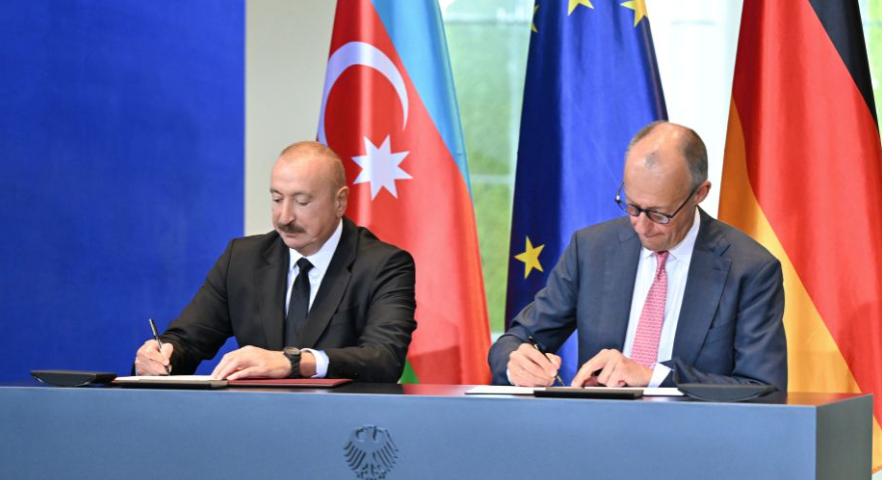
BERLIN, July 21, 2026 (BSS/AFP) - The leaders of Germany and Azerbaijan said Tuesday they wanted to deepen cooperation on energy exports to Europe, with Azerbaijani President Ilham Aliyev calling for new European funding for gas pipelines.
"We want to continue diversifying our energy supply with Azerbaijan," Chancellor Friedrich Merz said at a press conference alongside Aliyev, whom he received with military honours at the chancellery in Berlin.
The two countries signed off on a "strategic agenda" on Tuesday which includes cooperation on "energy flows, including gas".
In recent years, Azerbaijan has become a key energy supplier for Europe, as countries seek alternatives to Russian oil and gas in the wake of the ongoing war in Ukraine.
Energy supplies have been further complicated by the Iran war and its impact on naval traffic through the Strait or Hormuz.
However, Aliyev said that in order to supply more gas, which Baku began delivering to Berlin early this year, "new interconnections and new gas pipelines" are needed, as well as "funds to carry out the necessary investments".
The Trans Adriatic Pipeline (TAP) and the Trans Anatolian Pipeline (TANAP), which go from Azerbaijan to Europe via Georgia and Turkey, "are operating at full capacity," he added.
TAP's capacity can be doubled, but only at the cost of heavy investment.
In 2019 the European Investment Bank (EIB) decided to stop financing projects linked to fossil fuels in order to focus on cleaner energy.
"It would be good if European banks revisited their decisions," Aliyev said, particularly with the "worsening" situation in the Middle East and the fact that some Russian refineries have been "destroyed" or " put out of service".
The Iran war has caused export difficulties for major producers such as Qatar, sharply driving up gas prices.
According to a growth forecast by Germany's Ifo economic institute published before the resumption of strikes between the United States and Iran in early July, the surge in fuel prices caused by the closure of the Strait of Hormuz will cost Germany 0.4 percentage points of GDP growth in 2026 and 2027.