News Flash
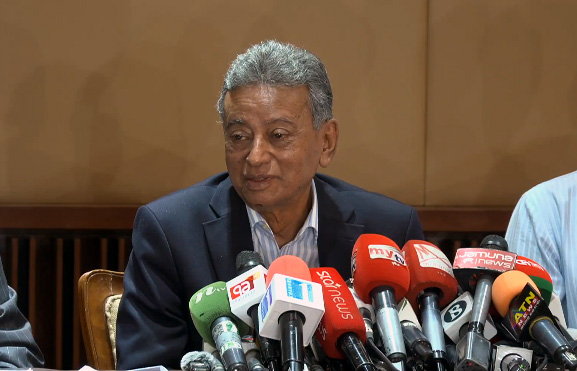
DHAKA, May 18, 2026 (BSS) – Finance and Planning Minister Amir Khosru Mahmud Chowdhury today said Bangladesh is steadily emerging as the next major investment destination due to the government’s reform initiatives, leadership commitment, rapid decision-making and ambitious development agenda.
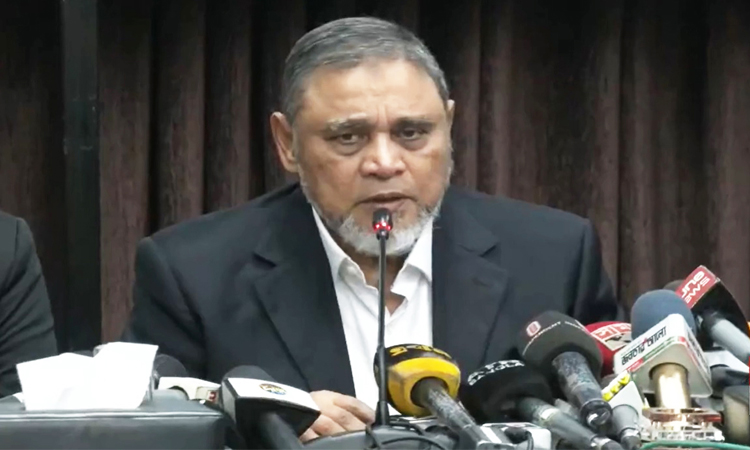
Speaking at a press briefing after the day’s National Economic Council (NEC) meeting, the minister said the government’s Taka 3,00,000 crore Annual Development Programme (ADP) has been designed to pull the economy out of fragility through large-scale investments and employment generation.
“If aspirations are not high, development cannot move forward,” he said while responding to questions on whether the fresh ADP is overly ambitious.
“To move forward from the setbacks and stagnation of previous years, investment is essential. Without investment there will be no growth, no employment and no development,” he added.
The minister said the government remains confident about implementing the large development budget because of stronger political commitment and administrative efficiency under an elected government.
“This is a matter of commitment. We have already shown within three months that we can take decisions quickly and implement them,” he said.
Explaining why the government opted for a large ADP despite inheriting a fragile economy, the minister used the analogy of a tube-well.
“When the water level in a tube-well goes down, water has to be poured into it before water starts flowing again.
Likewise, without injecting investment, there is no way to recover from a fragile economy,” he said.
The minister said the government’s economic strategy is already generating positive responses from international investors and financial institutions.
“Global investors, fund managers and international institutions are now closely following Bangladesh,” he said.
Referring to recent discussions with foreign investors, he said officials from JP Morgan informed the government that they were interested in Bangladesh because of the direction of the country’s readership.
“They told us they operate in 66 countries but are coming to Bangladesh because they are observing where Bangladesh’s leadership is heading,” he said.
The minister said investors are being attracted by the leadership’s commitment, dynamism and fast-paced decision-making process.
“Investors are coming because they see commitment, dynamism and quick decision-making. Bangladesh is becoming acceptable to the world as the next investment destination,” he said.
Replying to a question on revenue mobilisation, the minister acknowledged that Bangladesh’s tax-GDP ratio remains among the lowest in the world.
“That situation cannot continue if we want to become a stronger economy,” he said.
He said the government is implementing reform programmes in the National Board of Revenue (NBR) and expanding the tax network to bring more people under the tax system.
“For many years, the same taxpayers have carried the burden while the network did not expand. We are now widening the network,” he said.
The minister said bringing more people into the tax net would eventually benefit citizens through better public services and social protection.
“This is an elected government. Earlier, benefits went into a few pockets. Now the benefits will go to the people of Bangladesh,” he said.
He also defended increased allocations for social protection and targeted assistance programmes, saying different support schemes serve different groups.
“A farmer receiving a farmer card is not the same person receiving a family card. These are targeted programmes designed for different beneficiaries,” he said.
The minister reiterated that the government’s development strategy would focus on employment generation, human resource development, healthcare, technical education and climate resilience to ensure sustainable long-term growth.