News Flash
By Tahmid Shakib
RAJBARI, June 16, 2026 (BSS) - For years, the arrival of the dry season has brought nothing but anxiety to Mohammad Sobuj Molla, a small businessman and farmer in Char Jikri village under Rajbari's Pangsha Upazila . As the groundwater level plummets and the riverbank soils dry up, Sobuj watches helplessly as the lack of water cripples his livelihoods and forces local farmers into severe financial losses.
This year was no different. "Due to the acute irrigation water crisis, we could not even cultivate our main cash crop, jute, on time," Sobuj said, pointing toward his dry, cracking fields . "During the dry season, the groundwater level drops so low that even our ordinary boring pumps fail to lift any water."
For Sobuj and his neighbors, the biggest blow comes after the harvest. Jute requires vast pools of water for retting, but with nearby water bodies completely dried up, farmers have been unable to process their crops, facing heavy losses. Standing near the riverbank, Sobuj recalled how previous attempts to solve their misery failed years ago. Then the initiative was abandoned and never saw the light of day.
Now, Sobuj and other villagers demand permanent solution. "If Padma Barrage is constructed here, there will be no water shortage even in the driest of seasons," he said. "It will bring a massive, positive change to our local agricultural economy."
Sobuj's struggle is not isolated. It is the shared reality of millions of residents living across the Ganges-dependent South-western regions of Bangladesh . To address this widespread crisis, the government has recently approved the Tk 34,497-crore Padma Barrage (1st Phase) Project. Approved by the Executive Committee of the National Economic Council (ECNEC) in May 2026 under the chairmanship of Prime Minister Tarique Rahman, this mega-infrastructure project is slated for implementation over a seven-year period from July 2026 to June 2033.
The project has rekindled hopes of a complete socio-economic revolution in these marginalized char lands. In 'Char Jikri Beribandh Para' village, local women Sufura Begum, Sajeda Begum, and Hazera Khatun spoke of their daily hardships due to the dry-season water crisis. They strongly appealed for the rapid execution of the barrage, noting that the project would bring immense benefits to thousands of local families.
Local residents and water experts believe that securing year-round irrigation will allow multi-cropping, which will create massive employment opportunities for landless farmers and agricultural laborers. Furthermore, conserving water in the barrage's canals and reservoirs will open up extensive opportunities for commercial fish farming, offering a viable source of livelihood for local youths.
The water crisis has transformed entire landscapes and communities. Fifty-two-year-old Biplob Mondal has spent his entire life in Barodag village, nestled right next to Kushtia's historic Hardinge Bridge and the Lalon Shah Bridge.
A true "son of the river," Biplob has spent forty years catching fish, operating boats, and trading sand on the Padma. "In my childhood, the river ghat had a depth of about 160 to 180 feet," Biplob recalled with a heavy heart. "Today, due to heavy siltation and the lack of water flow, the riverbed has filled with sand and mud, leaving the depth at a mere 20 feet."
This drastic reduction in water levels has devastated local fisheries, leaving traditional fishermen with virtually no catch. Biplob pointed out that the rice cultivation of a major portion of the Khulna division is heavily dependent on Ganges water, which is now severely disrupted by the drying river.
"The lack of water in the river during the dry season is pushing us toward extreme hardship and a famine-like situation," Biplob said, stressing that systematic water management through the barrage is the only way to save the region from desertification.
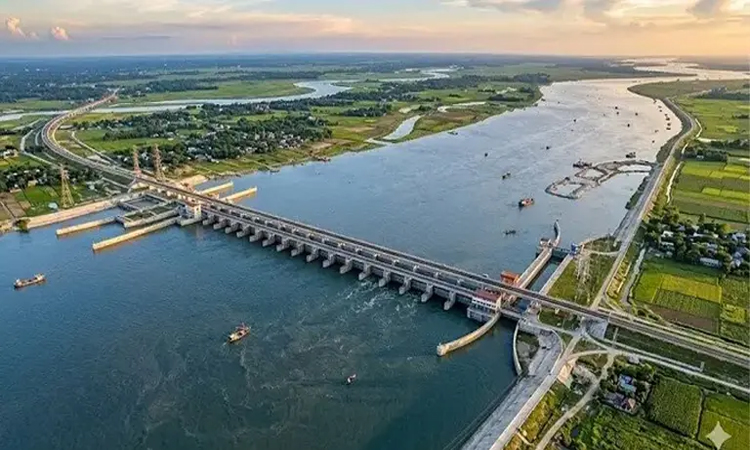
To be executed by the Ministry of Water Resources and the Bangladesh Water Development Board (BWDB), the project features a 2.1-kilometer-long main barrage at Pangsha Point in Rajbari, designed with 78 spillway gates, 18 undersluice gates, fish passes, and navigation locks .
The primary objective of the project is to retain water during the dry season and restore continuous flows into major Ganges distributaries, including the Gorai, Modhumati, Chandana, and Hisna rivers . BWDB officials stated that maintaining the river's water level at approximately 10 meters will comfortably meet the needs of the Ganges-Kobadak (G-K) irrigation scheme, expanding its active coverage from 55,000 hectares to 95,000 hectares .
Ultimately, around 70 million people across 19 districts in the Dhaka, Khulna, Barishal, and Rajshahi divisions are expected to benefit from enhanced water security, increased crop yields, and minimized salinity intrusion .
While the project has brought immense hope, environmentalists and water experts urge caution, highlighting the potential environmental footprint of such large-scale river interventions .
Former Water Resources Secretary and Retired Chief Engineer Aktar Hossain warned that unchecked salinity intrusion could make parts of the Khulna region uninhabitable by 2050 . While supporting the barrage as a vital solution, he emphasized that large-scale structures alter natural sediment dynamics and water quality .
He recommended using advanced computerized models to conduct comprehensive impact assessments to minimize ecological disruptions .
Additionally, former Vice-Chancellor of Jahangirnagar University and International Farakka Committee (IFC) Bangladesh Chief Adviser Prof. Jasim Uddin Ahmad highlighted the long-term risks associated with heavy metal pollution in river sediments .
He suggested that transboundary negotiations with upstream nations should address water quality and sediment pollution alongside water quantity, citing international frameworks like the Rhine River management between Germany and the Netherlands.
D. Imran Ansary , executive director, Bangladesh institute of development and security studies told BSS that the Padma Barrage is Bangladesh's historic answer to decades of dry season water crisis. By storing 2,900 million cubic meters of monsoon water, it will irrigate 2.88 million hectares, generate 113 MW of electricity, reduce salinity in the southwest, and revive dying rivers. This Tk 34,347 crore fully domestic-project will boost GDP by 0.45 percent, protect millions from river erosion, and restore the Sundarbans. Completed by 2031-2033, it asserts Bangladesh's water self-reliance and will transform agriculture, ecosystems, and lives across 19 districts-truly a game-changer for our delta's future.
Sayed Tipu Sultan, chairman, International Farakka Committee, who led a team of journalists on a trip to the Ganges-dependent areas of Kushtia and Rajbari said the Ganges water sharing issue should be taken to the United Nations if it is not solved mutually.
The eyes of millions of people in south-western Bangladesh, including Sobuj Molla and Biplob Mondal, remain fixed on the project, hoping the barrage will successfully restore their rivers, protect their lands, and secure their future.