News Flash
By S M Zahid Hossain
KHULNA, Feb 20, 2026 (BSS) - Abu Hanif Morol, a farmer of Kharnia village in Dumuria upazila of the district, has changed his fortune by cultivating colourful cauliflower during the current winter season.
Once a day labourer struggling to support his four-member family, Hanif has now become self-reliant through successful farming of high-value vegetables. On a trial basis, he cultivated colourful cauliflower on 20 decimals of land using around 1,000 seedlings.
With technical support, organic fertilisers and guidance from the upazila agriculture office, he achieved remarkable success.
Talking to BSS, Hanif said he had already sold produce worth about Tk 50,000 from an investment of only Tk 7,000 and expects to earn another Tk 60,000 to Tk 70,000 from the remaining harvest.
"I used to work as a day labourer on other people's land. It was very difficult to run my family with limited income," he said.
"For the last two years, I cultivated white cauliflower on my small plot but did not get good returns. This year, colourful cauliflower changed my fortune and helped me become self-reliant," he added, expressing hope to expand cultivation next season.
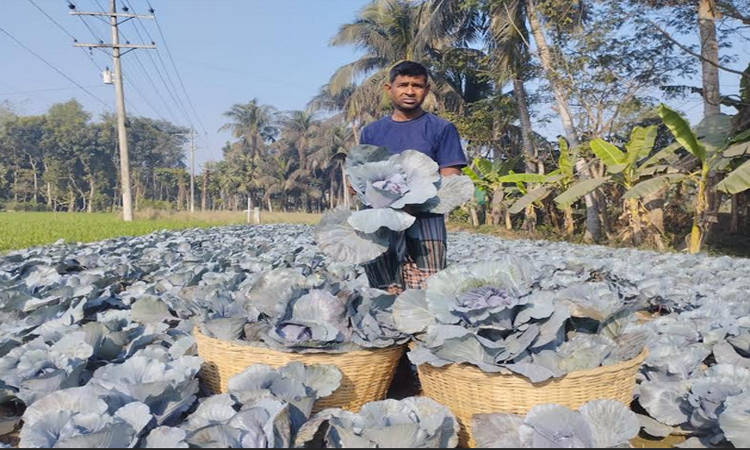
Like Hanif, many farmers in Dumuria upazila are achieving encouraging success by cultivating colourful varieties of cauliflower and cabbage, which are bringing both aesthetic appeal and higher profits during the winter vegetable season.
Fields across several villages now display vibrant shades of yellow, pink, purple and bluish cauliflower heads nestled among green leaves, resembling blooming flower gardens rather than vegetable fields. The visually attractive produce has drawn significant attention from buyers, creating strong market demand.
According to local agriculture officials, cultivation of these high-value colourful vegetables has expanded in parts of Khulna district under various government-supported initiatives.
Farmers are adopting eco-friendly pest management techniques, including pheromone traps and yellow sticky traps, instead of chemical pesticides. As a result, they are producing safe, chemical-free vegetables with satisfactory yields.
Farmers said losses incurred from some other seasonal vegetables this year have been offset by the profitable sale of colourful cauliflower and cabbage. Wholesale traders are purchasing directly from the fields, while local markets are selling the vegetables at Tk 30 to Tk 40 per piece or kilogram, compared to Tk 10 to Tk 15 for ordinary white cauliflower.
Several other farmers, including Mrityunjoy, Rashedul Islam and Imtiaz, also reported good yields and profits. Many said they relied solely on organic pest control methods, which reduced production costs while meeting growing consumer demand for safe vegetables.
Vegetable trader Monirul Islam at Dumuria Bazar said the colourful varieties are selling quickly due to their attractive appearance and perceived nutritional value.
Local consumer Rahmat Ali said he bought the vegetable again after trying it earlier. "It looks beautiful and tastes good," he added.
Dumuria Upazila Agriculture Officer Agriculturist Md Nazmul Huda said farmers have received promising yields and market prices from the cultivation of colourful varieties.
"These vegetables contain higher levels of antioxidants and carotene compared to conventional cauliflower, making them beneficial for health," he said.
This season, cauliflower has been cultivated on about 110 hectares of land in Dumuria upazila, including nearly 25 acres dedicated to colourful varieties such as yellow, pink and purple. Officials expect more farmers to adopt the crop commercially in the coming years due to its profitability and rising consumer demand.
Farmer Saberul Sheikh of Rajbadh village under Bhandarpara union said he cultivated colourful cauliflower on 10 decimals of land using seeds supplied by a private company.
"I used only organic pest control methods and pheromone traps. Due to high demand, wholesalers are buying directly from the field at good prices," he said.
Another farmer, Imtiaz, cultivated the crop for the first time on 22 decimals of land and produced about 1,500 pieces. His production cost was around Tk 12,000, and he has already sold cauliflower worth about Tk 30,000 at wholesale rates between Tk 30 and Tk 35 per piece.
"I made a good profit with relatively low investment and plan to expand cultivation next season," he said.
Farmer Tapas Sarkar of Boratia village planted nearly 5,000 seedlings of four cauliflower varieties along with broccoli, Chinese cabbage, red cabbage and traditional cabbage. Although prices of some winter vegetables were lower than expected, he said colourful cauliflower helped offset the losses.
Deputy Director Md Nazrul Islam of the Department of Agricultural Extension said colourful cauliflower and cabbage cultivation has been promoted in the district for the past two years under a sustainable agriculture development initiative.
"Many farmers have already achieved success. As these vegetables fetch good prices and are grown through safe methods, commercial cultivation will expand further," he said.
He added that the crops are grown without chemical pesticides or fertilisers, relying instead on biological control methods. Coloured cauliflower is rich in carotene-over 25 percent higher than conventional varieties-along with vitamins A, C and K, potassium, manganese and beta-carotene, which help boost immunity, improve eyesight and reduce health risks.
Agriculture officials expressed hope that expansion of high-value vegetables such as squash, capsicum, broccoli and coloured cabbage alongside coloured cauliflower will enhance farmers' income and ensure safe, nutritious food for consumers in Dumuria and across the wider Khulna district.