News Flash
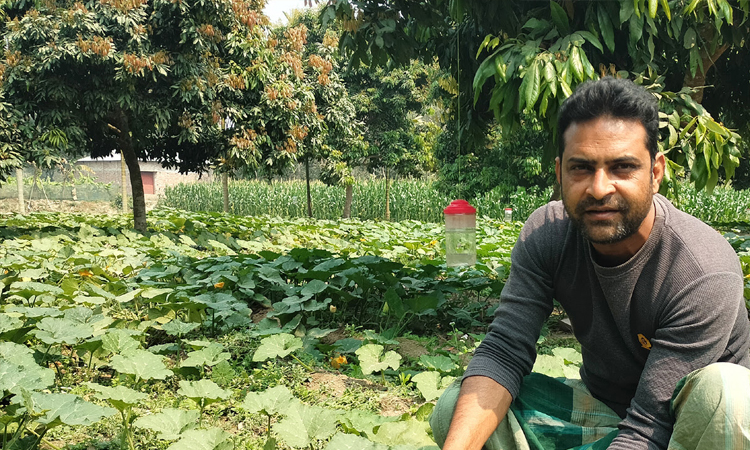
By Rostom Ali Mondal
DINAJPUR, April 5, 2026 (BSS)- Following the success of sweet pumpkin
cultivation in mango and litchi orchards in Bochaganj upazila, farmers in
Birganj upazila of the district have now achieved success in cultivating kaun
(foxtail millet), a resilient and nutrient-dense grain, as a companion crop
alongside groundnuts.
This intercropping method has created the potential for producing higher
yields from the same land within a shorter time, offering new hope for
improving the livelihoods of marginal farmers.
Md. Rafiqul Islam, 34, a young agricultural entrepreneur and son of Nazrul
Islam from Muraripur village under Shibrampur Union in Birganj upazila,
successfully cultivated Kaun alongside groundnuts on high land last year.
Encouraged by the results, he expects even better yields this year as he has
expanded cultivation.
Speaking to BSS, Rafiqul Islam said he first learned about Kaun cultivation
through YouTube and various research journals. Later, he sought guidance from
local Agricultural Field Officer Sabuj Ahmed and began practicing
intercropping.
He sowed groundnut seeds in the first week of the Bangla month of Agrahayan.
About 20 days later, he scattered Kaun seeds on the same land.
Both crops grew simultaneously, and within 75 to 80 days, the Kaun began to
ripen. Now, groundnuts are growing beneath while Kaun spikes are visible
above in the same field.
The young farmer said he expects to harvest the Kaun soon and will then focus
on proper care of the groundnuts to ensure a good yield.
Professor ATM Shafiqul Islam of the Agriculture Department at Hajee Mohammad
Danesh Science and Technology University said that Kaun was once widely
cultivated in Dinajpur and the northern region and was considered a staple
food for the poor.
"Due to changes in dietary habits and living standards, Kaun cultivation has
declined. However, there is now significant market demand for Kaun rice,
which is used to prepare high-quality dishes like "Payesh" and "Kheer".
Such dishes are even sold in reputed restaurants," he said.
Shafiqul added that with the use of modern technology, the amount of fallow
land is decreasing, and farmers are increasingly cultivating multiple crops
on the same land.
In Bochaganj upazila, several young entrepreneurs have already succeeded in
growing vegetables like sweet pumpkin and bottle gourd in mango and litchi
orchards.
Professor Shafiqul Islam also said he personally visited three orchards in
Bochaganj on behalf of the university and found companion cropping to be
profitable. Similarly, mustard is being cultivated in paddy fields in the
district. He cited the success of young farmer Nurul Islam in cultivating
Kaun in groundnut fields as another example.
He emphasized that with proper guidance and support, marginal farmers can
significantly increase production on limited land through intercropping.
He also stressed the need for in-depth research by universities to explore
new agricultural possibilities and support such initiatives.
It is known that students of the Agriculture Department at the university
receive hands-on training in crop cultivation, including Kaun. Many students
participating in field training have successfully applied their knowledge in
real-life farming.
Professor Shafiqul Islam further noted that a young farmer from Muraripur
village, Nurul Islam, recently achieved success by cultivating Kaun in
groundnut fields, setting an example for others.
He believes that if the younger generation becomes more engaged in innovative
farming, it will lead to a renaissance in agriculture.
Sabuj Ahmed, agricultural field officer of Shibrampur union, said many young
entrepreneurs are reviving Kaun cultivation using modern technology.
Cultivating Kaun alongside groundnuts on high land has yielded promising
results. Currently, Kaun rice is being sold at over Taka 100 per kilogram in
the market, and Nurul Islam is expected to make a good profit.
Birganj Upazila Agriculture Officer Md. Shariful Islam said that if young
people continue to adopt modern technologies in agriculture, it will bring
significant positive changes to the country's economy.
Deputy Director of the Department of Agricultural Extension (DAE) in
Dinajpur, Md. Afzal Hossain said, "Many entrepreneurs in the district have
succeeded in cultivating two crops simultaneously on the same land. The
agriculture department is providing continuous support and guidance to such
farmers."
There are many mango and litchi orchards in the district, and farmers are
being encouraged to adopt companion cropping in these orchards, he added.
The DAE is working to ensure greater success for farmers in intercropping
practices in the future.