News Flash
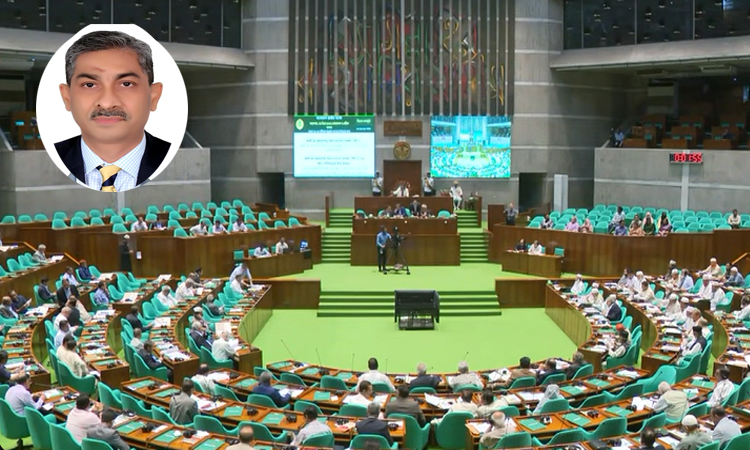
SANGSAD BHABAN, June 21, 2026 (BSS) – Water Resources Minister Md. Shahiduddin Chowdhury Anee today said the Padma Barrage Project is highly important and feasible for the national interest, particularly for the country’s water resources management, agriculture, fisheries, environment, and regional economic development.
“The project has been approved following comprehensive scrutiny and evaluation, considering the overall situation, long-term planning, and the need to safeguard national interests,” he said.
The minister said this while replying to a tabled written question placed in parliament by Opposition Member Md Nurul Islam from Chapainawabganj-3 constituency.
He said arrangements have also been made to appoint national and international expert consultants to ensure the effective implementation of the project.
The minister informed the House that the Padma Barrage Project is not a new concept.
Between 1960 and 2000, four international studies were conducted to identify suitable locations for the construction of a barrage, he said.
Subsequently, a pre-feasibility study carried out by the Water Resources Planning Organization (WARPO) in 2002 recommended Thakurbari in Kushtia and Pangsha in Rajbari as potential sites.
He said the project’s feasibility study was approved in 2005 and completed in 2013 by a consortium comprising four local and three international consulting firms, along with five local associate organizations.
The design prepared on the basis of the study recommendations was thoroughly reviewed by the Bangladesh Water Development Board (BWDB) and finalized following assessments and opinions from the relevant high-level technical committee.
According to the minister, analyses of satellite imagery from 2011 to 2025 and field-level observations indicate that riverbanks in the proposed area have remained stable.
At the same time, the formation of char lands has created favourable environmental and technical conditions for the construction of the barrage.
He further said analyses of various datasets obtained from the Joint Rivers Commission (JRC) covering the period from 1997 to 2025 show that, even under extreme conditions, operation of the barrage would ensure the required water supply throughout the major river systems within the project area.
“After reviewing all relevant information and data, the project has been undertaken in the national interest,” he added.
The minister noted that hydro-morphological changes during the implementation of a project on a large and dynamic river like the Padma are not unusual.
Therefore, provisions have been made to engage national and international consulting experts to review and update the design and ensure necessary adaptations throughout implementation.
These consultants will be responsible for reviewing the approved design at the outset, recommending necessary modifications, and providing continuous supervision during project execution.
He also informed the parliament that, considering the complexity of the project, a seven-member expert panel has been formed under the leadership of a renowned retired water resources specialist from the Bangladesh University of Engineering and Technology (BUET).
The panel will provide technical guidance and assist in resolving any engineering challenges during implementation.
The minister expressed confidence that these measures would ensure transparency, efficiency, and timely implementation of all activities under the Padma Barrage Project.