News Flash
VIÑA DEL MAR, Chile, Jan 3, 2025 (BSS/AFP) - After a wildfire that devastated
Chile's largest botanical garden, the century-old park has planted thousands
of native trees that it hopes are less likely to go up in flames.
Last year's inferno -- considered the deadliest in Chile's recent history --
killed 136 people, razed entire neighborhoods and destroyed 90 percent of the
400-hectare (990-acre) garden in the coastal city of Vina del Mar.
Park director Alejandro Peirano thinks it is only a matter of time before the
wildfires return.
"One way or another, we're going to have a fire. That's for sure," he told
AFP, standing under one of the trees that survived the flames.
With authorities predicting another intense season of forest fires due to
rising temperatures, the park wants to make sure it is better placed to
survive.
It established a new "battle line" with trees such as litre, quillay and
colliguay that are native to Mediterranean forests found in areas with hot,
dry summers.
"The idea is to put the species that burn more slowly in the front line of
the battle... so that fires, which will happen, don't advance so quickly,"
Peirano said.
- Recovery takes root -
Summer heat and strong gusts of wind meant that the February 2024 fire ripped
quickly through Vina del Mar, 120 kilometers (75 miles) northwest of
Santiago, leaving 16,000 people homeless.
The Vina del Mar National Botanical Garden, first designed by French
architect Georges Dubois in 1918, boasted 1,300 species of plants and trees,
including native and exotic ferns, mountain cypresses, Chilean palm and
Japanese cherry trees.
Some came from seeds that survived the atomic bombing of Hiroshima in 1945.
The park was home to wildlife including marsupials, gray foxes and countless
birds.
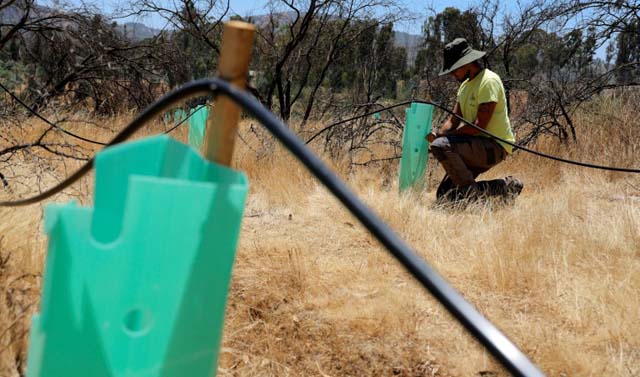
Weeks ago on one of the garden slopes, dozens of volunteers began to plant
5,000 native trees that are watered through an irrigation system.
In two years, the foliage is expected to be large enough to provide shade and
encourage the regrowth of other species around them.
The tree planting is part of the first stage of a plan to revive the garden
through a public-private partnership.
The park is also expected to be reforested with species capable of adapting
to "scarce rainfall and prolonged drought," said Benjamin Veliz, a forest
engineer with Wildtree, a conservation group involved in the project.
Firebreaks are also being created on the park's edges and its ravines are
being cleared of dry vegetation and trash that feed fires.
Unlike eucalyptus, an exotic species that burns quickly, some native trees
are able to withstand or contain flames for longer, according to research by
the Federico Santa Maria Technical University (USM).
Scientific experiments have demonstrated that quillay and litre, for example,
are less flammable than eucalyptus and pine, USM researcher Fabian Guerrero
said.
When the inferno erupted last February, there was little firefighters could
do to stop it consuming most of the park in less than an hour.
But nature is slowly healing: abundant rainfall in 2024 in central Chile --
after more than a decade of drought -- has already brought green shoots of
recovery in the botanical garden.
The beauty of Sclerophyll forests resistant to summer droughts is that "trees
that burn come back," Peirano said.