News Flash
KHULNA, May 10, 2026 (BSS) - Khulna University (KU) has entered the final stage of preparations to secure accreditation for 10 academic disciplines, Vice-Chancellor Professor Dr. Md. Rezaul Karim said on Sunday.
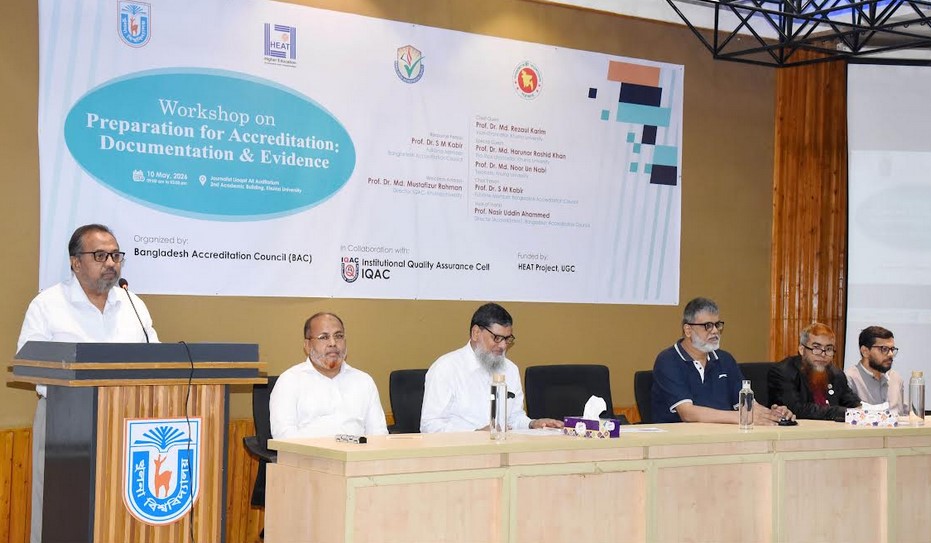
He made the announcement while speaking at the opening session of a daylong workshop titled "Preparation for Accreditation: Documentation and Evidence" at the university's Journalist Liaquat Ali Auditorium.
The workshop was jointly organised by the Bangladesh Accreditation Council (BAC) and the university's Institutional Quality Assurance Cell (IQAC).
Addressing the programme, the vice-chancellor stressed that accreditation is essential for achieving international standards in higher education. He highlighted the importance of maintaining proper documentation, preserving information, and preparing strong evidence for evaluation in every discipline.
"There is no alternative to quality education. Achieving it requires time and continuous effort," he said.
Professor Rezaul Karim also noted that Khulna University is progressing faster than many other universities in the accreditation process. To strengthen monitoring and coordination, the university has already developed dedicated software to track accreditation activities.
He expressed optimism that the final application for accreditation would be submitted soon, adding that successful accreditation would open new opportunities for other disciplines in the future.
The session was chaired by Bangladesh Accreditation Council full-time member Professor Dr. SM Kabir. KU Treasurer Professor Dr. Md. Nurunnabi attended as a special guest, while IQAC Director Professor Dr. Md. Mostafizur Rahman delivered the welcome address.
During the technical session, Professor Dr. SM Kabir presented keynote papers on "Preparation for Accreditation: Documentation and Evidence" and "Self-Assessment."
Meanwhile, Professor Dr. Md. Zakir Hossain, head of the Urban and Rural Planning (URP) Discipline, presented a paper titled "Preparation of BAC Application Documents: An Update."
The workshop was financed under the Higher Education Acceleration and Transformation (HEAT) Project of the University Grants Commission (UGC).