Wednesday
19 August, 2026
By Md. Manjur Morshed
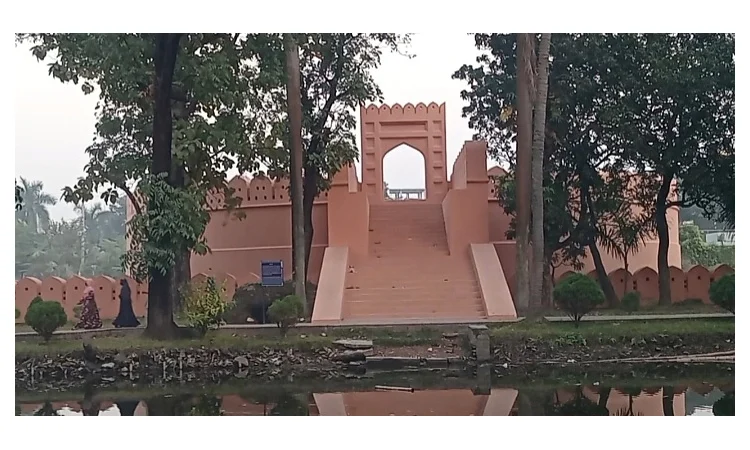
MUNSHIGANJ, Dec 8, 2025 (BSS) - Idrakpur Fort, a remarkable example of Mughal architectural brilliance, stands prominently in the heart of Munshiganj town as a timeless witness to nearly four centuries of history.
Built in 1660 under the reign of Mughal Emperor Aurangzeb (1658–1707) and during the tenure of Bengal Subedar Mir Jumla, the fort mirrors the architectural style of Dhaka’s Lalbagh Fort. It measures 86.87 meters in length and 59.60 meters in width.
Located on the southern edge of Munshiganj beside the Dhaleshwari River, the fort reflects the strategic military planning and advanced engineering of the Mughal period. Although many parts have deteriorated with time, its iconic circular high tower remains intact, continuing to narrate the fort’s glorious past.
Historians said that after consolidating control over Bengal, the Mughals prioritized building a strong river-centric defense system to combat their major adversaries—particularly the Arakanese (Magra), Portuguese, and Dutch pirates who plundered Bengal through the Bay of Bengal and the Meghna–Brahmaputra river routes.
To safeguard important river-bound towns and commercial routes, the Mughals established three major water forts along the Meghna, Ichamati, and Shitalakshya rivers. Idrakpur Fort was one of these, alongside Sonakanda and Hajiganj forts in Narayanganj.
Beyond repelling pirates, Idrakpur Fort played a vital role in protecting trading vessels that carried Dhaka’s famous muslin, metal crafts, and agricultural products to Persia, Arabia, and Mediterranean regions. The structure was also crucial for ensuring the security of Dhaka city and Lalbagh Fort, especially against threats approaching via rivers through Bikrampur and Sonargaon.
After Shah Shuja’s fall in 1660, Mir Jumla assumed the role of Subedar of Bengal and recognized Dhaka as the strategic center for suppressing rebellions and resisting pirate attacks.
During his short administration (1660–1663), he ordered the construction of Idrakpur Fort. A naval fleet of about 200 vessels—including Kosha, Jalba, Parinda, Bajra, Tahera, Salab, Olil, Khatgiri, and Malgiri—was stationed alongside the fort under the command of Abul Hossain. This fleet was the first line of defense against pirates advancing toward Dhaka.
The quadrangular fort is divided into three main sections: the central tower, the primary fort area, and a two-tier wall system incorporating a reservoir. The most distinctive feature is the massive circular turret at the center, standing 9.14 meters high with a diameter of 32.91 meters. The top platform, shaped like lotus petals, contains several firing holes designed to target enemies both near and far.
A two-level staircase descends from the tower to an internal reservoir, which served as a water source for soldiers and as fire protection during dry months. A secret staircase, now covered, once connected the tower to underground armories and possibly to distant observation points.
The fort’s main entrance on the north side is 13 feet high and 7.5 feet wide, built in traditional Mughal style. Four corner towers, each 3.5 feet wide, supported cannon placements, while a 3-foot boundary wall acted as the primary defensive barrier. The walls, constructed using lime, mortar, and bricks, feature numerous arrow holes.
During renovation work in 2015, hundreds of specialized clay jars were discovered beneath the tower floor—believed to have been used during construction for moisture control. Another unique feature attributed to Mir Jumla is the use of an artificial moat around the fort, filled with river water to prevent enemy approach.
In later periods, Idrakpur Fort served as the residence of sub-district and district administrators. During British rule, it housed a prison. Declared a protected antiquities site in 1909, the fort now features a museum and remains a major tourist attraction, drawing large numbers of visitors daily.