News Flash
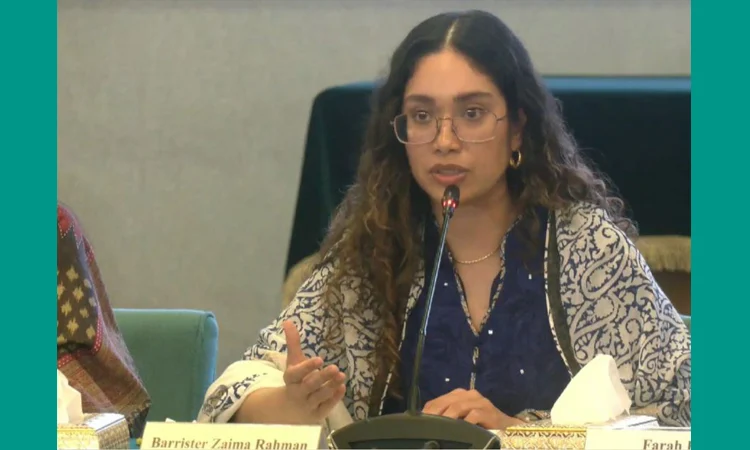
DHAKA, Feb 8, 2026 (BSS) - Zaima Rahman, daughter of Bangladesh Nationalist
Party (BNP) Chairman Tarique Rahman, today said political parties should play
a key role in advancing women in politics.
She said it is easy for men to take a position in Bangladeshi politics, but
difficult for women, and that is why political parties need to play a big
role in putting women forward in politics.
Zaima, also the granddaughter of former Prime Minister Begum Khaleda Zia,
made the remarks while speaking at a discussion at an auditorium in the
capital.
The meeting titled 'Women in the Struggle for Democracy: Contribution and
Future Bangladesh' was organised by Women in Democracy (WIND).
Zaima Rahman said every political party should have a code of conduct to
ensure the safety of women who are active in politics.
"If anything happens to a woman leader or student leader in terms of safety,
then the parties will protect the woman through the legal code of conduct.
That means if something happens to a woman, the party will take
responsibility to protect her and stand by her," she said.
Zaima Rahman, who studied law in London, returned to the country after 17
years and has already involved in active politics by participating in the
election campaign for her father Tarique Rahman in the upcoming nation
elections.
She said political parties should provide support and training opportunities
for women so that they can come forward towards politics. "All parties should
take this responsibility."
Stressing the need for providing financial support to women in politics, she
said women should be given an opportunity to contest in parliamentary or
local government polls.
She also commented that it is necessary to change the society's attitude
towards women leaders.
Participating in the discussion, ActionAid Bangladesh country director Farah
Kabir highlighted the trend of trying to remove women from leadership
positions, focusing on the upcoming 13th national elections.
"For so long, women have been in leadership positions in various places, but
in the last 18 months, I have felt anew, will all these women go back now?
This is how they are being pushed towards divide and rule," she said.
So, she said, the people of the country will have to decide in the February
12 elections what kind of leadership they want.
Highlighting the need for a shift in the country's political culture, Farah
Kabir said women are often discouraged from leadership because politics is
labeled as "dirty." She stressed that this mindset has to change and urged
women to step up and take part in politics to help transform the culture.
Barrister Sara Hossain said although there was a promise to eliminate
discrimination in the July Charter and the referendum, it was not made clear
how this promise would be strengthened.
Lawyer Sarwat Siraj Shukla said in the last 18 months, women have come
forward in one game and it is the game of self-defense. "Currently, slut-
shaming and harassment of women online and offline has increased much more
than before," she said.
Labour leader Kalpana Akhtar said, "We want whoever wins the election to be
respectful of women. Because, every time there is an attempt to push women
back, women will fight back. If we take two steps back, we will take four
steps forward."
Freedom fighter Lutfa Hasan Rozy said the environment needed for equal rights
is still not there in Bangladeshi society. Women will have to come forward
the most to build this democratic culture in society, she said.
Umama Fatima, former central coordinator of the anti-discrimination student
movement, said the women who came forward in the mass uprising were excluded
after August 5. Various political parties are now also confronting women in
different ways, she said, calling upon all to take initiatives to stop the
cyberbullying against women.
Professor Mirza Taslima of Jahangirnagar University, Dhaka-12 parliamentary
candidate Taslima Akhter, Professor Nahrin Islam Khan of Jahangirnagar
University, Professor Shamima Sultana of Jahangirnagar University, journalist
Zayma Islam, DUCSU executive member Hema Chakma, DUCSU Research and
Publications Secretary Sanjida Ahmed Tonni, among others, also spoke at the
discussion hosted by TV presenter Kazi Jessin.