News Flash
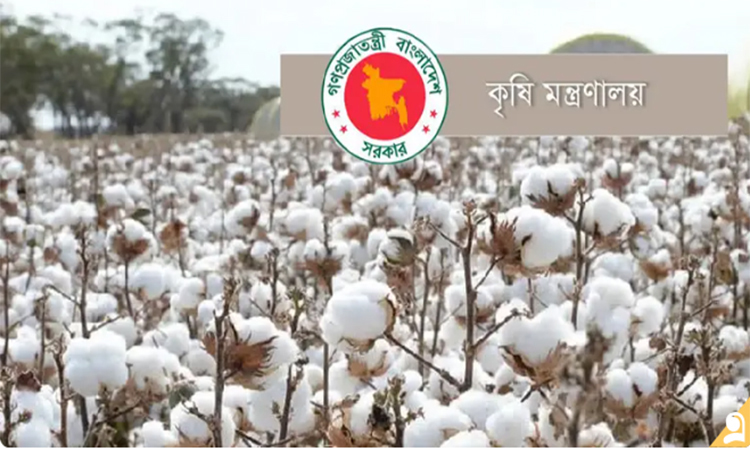
DHAKA, May 20, 2026 (BSS) - The government has earmarked Taka 20 crore as incentive for cotton growers in the 2026-27 fiscal year aiming to increase domestic cotton production and support marginal farmers across the country.
Officials of the Cotton Development Board (CDB) said nearly 25,000 farmers in 26 districts will receive seeds, fertilizers and pesticides for cultivating cotton as an intercrop on one bigha of land.
"The incentive is being provided for the third consecutive time to increase cotton production and provide financial support to poor and marginal farmers," said CDB soil fertility and water management expert Dr M Gazi Golam Mortuza.
Under the programme, each farmer will receive agricultural inputs worth Tk 8,000, including 600 grams of hybrid cotton seed, 50 kilograms each of triple super phosphate (TSP) and Muriate of Potash (MoP), two kilograms of boron fertilizer, 450 millilitres of fungicide and 150 millilitres of growth regulator.
Officials said the incentive is expected to encourage farmers to expand cotton cultivation and help reduce the country's dependence on imported raw cotton.
CDB Executive Director Md Rezaul Amin said cotton cultivation has become highly profitable for farmers.
"The production cost for cultivating cotton on one bigha of land is around Tk 15,000, while a farmer can earn nearly Tk 60,000 by producing 15 maunds of raw cotton," he said.
He added that local cotton production also helps save foreign currency as every kilogram of domestically produced cotton reduces government import costs by around US$4.
According to the CDB, cotton sowing usually begins in mid-June and harvesting continues until December.
Senior Ginning Officer Mohammad Mofazzal Hossain said cotton cultivation also contributes positively to soil health.
"Repeated maize cultivation on the same land degrades soil fertility, whereas cotton cultivation helps improve soil conditions," he said.
The incentive beneficiaries include 6,200 farmers in Kushtia zone, 5,500 in Chuadanga zone, 3,200 in Jenaidah zone, 3,000 in Jeshore zone, 2,000 in Rajshahi zone, 1,200 in Bogura zone, 1,200 in Mymensingh zone, 680 in Rangpur zone, 500 in Thakurgaon zone and 380 farmers each in Dhaka, Bandarban, Rangamati and Khagrachari zones.
The Ministry of Agriculture will release the funds to deputy commissioners of the respective districts, while the inputs will be distributed from next month in coordination with district-level chief cotton development officers.
Earlier, the government allocated Tk 9.90 crore for 12,375 farmers in 2023-24 and Tk 16.88 crore for 21,100 farmers in 2025-26 under similar incentive schemes.
CDB scientists said the introduction of genetically modified cotton varieties has also played a significant role in increasing yields and reducing import dependency.
They noted that Bangladesh's southern, western, northern and central regions are suitable for cultivating both upland and hill cotton.
Currently, cotton is cultivated on around 45,000 hectares of land in the country, producing nearly 201,272 bales annually.
However, local production meets only 3 to 4 percent of the national demand, while the country's textile industry requires an estimated 7.5 to 8 million bales of cotton every year.
In the 2025-26 fiscal year, Bangladesh imported around 7.3 million bales of raw cotton at a cost of approximately Tk 45,000 crore, according to official data.