News Flash
By Md Aynal Haque
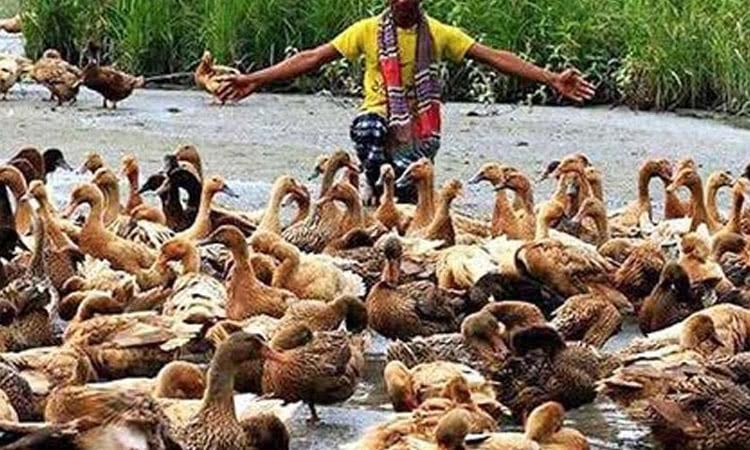
RAJSHAHI, March 3, 2026 (BSS) - Duck farming has emerged as a successful and reliable source of income in Rajshahi region, creating self-employment opportunities for marginalised families, unemployed youth and rural women.
High demand for duck eggs and meat, coupled with comparatively low production costs, has made the sector increasingly profitable. Many farmers are also adopting integrated farming methods, combining duck rearing with fish cultivation to maximise returns.
Government support, including the supply of vaccines, improved ducklings and technical assistance, has further boosted the sector, officials said.
Rakesh Babu, 54, of Gopalpur village under Godagari upazila, is one of the successful entrepreneurs in the field. He started his venture about four years ago with 175 ducklings collected from Kakonhat. At present, he owns around 1,500 ducks.
"I rear one-day-old ducklings for about four months until they start laying eggs. Every day I spend nearly Tk 5,000 on feed, medicine and employees' salaries. The upazila livestock office provides vaccines," he said.
Babu now collects around 900 eggs daily on average and earns nearly Tk 1.20 lakh per month. After a long period of unemployment, he is planning to expand his farm further.
Similarly, Rubel Islam, 35, of Bakshimoil village under Mohanpur upazila, has achieved financial solvency through duck farming. He began with 300 ducklings and now sells 200 to 250 eggs daily on average, alongside ducks in wholesale markets.
"I had to work as a day labourer due to poverty and lack of education. Now I earn around Tk 20,000 to 25,000 per month from duck farming," he said.
Rajshahi Divisional Director of the Department of Livestock Dr Ananda Kumar Adhikery said many people in the region have found the path to self-reliance through duck and poultry farming.
"We are providing technical support and consultation services to farmers to expand this sector," he said.
He noted that ducks require simple housing and comparatively low management, making the initial investment affordable. They are hardy birds, adaptable to various environmental conditions and can be fed with homemade feed such as rice polish, boiled rice and broken rice.
Prof Dr Jalal Uddin Sarder of the Department of Animal Husbandry and Veterinary Science at Rajshahi University told BSS duck farming is contributing to poverty alleviation, employment generation and improved nutrition.
"In many areas, women-especially housewives-are actively involved in rearing indigenous ducks, which is helping address socio-economic challenges," he said.
However, he identified high feed prices and scarcity during the dry season as major constraints. Increased use of natural feed resources, regular vaccination and balanced diets could significantly enhance production, he added.
While talking to BSS, General Secretary of Bangladesh Livestock Society Dr Hemayetul Islam said there is consistent market demand for duck eggs and meat in the region.
"Many farmers are earning between Tk 20,000 and Tk 25,000 per month, while larger farms are making around Tk 1.20 lakh monthly," he added.
Officials believe that with continued policy support and technical guidance, duck farming will further strengthen rural economy and small-scale entrepreneurship in the region.