News Flash
By Md Aynal Haque
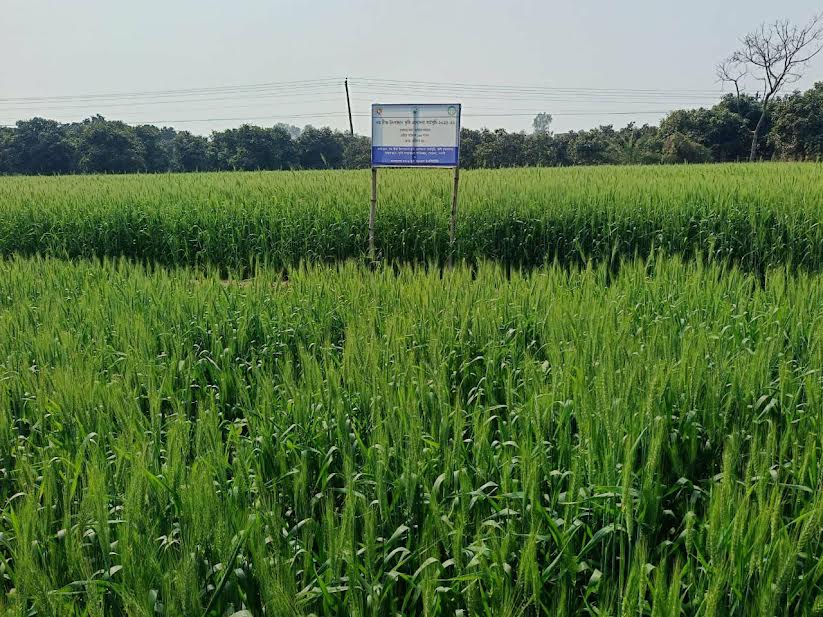
RAJSHAHI, March 6, 2026 (BSS): Farmers have cultivated wheat on about 1.25 lakh hectares of land across Rajshahi division during the current Rabi season, raising hopes for a good harvest as favourable weather conditions continue to support crop growth.
Officials of the Department of Agricultural Extension (DAE) said the wheat plants are growing well in all eight districts of the division since the beginning of the season due to suitable climatic conditions.
The DAE has set a target to produce around 5.40 lakh metric tonnes of wheat from 1.29 lakh hectares of land in the region this season.
Farmers and agriculture officials expressed optimism about achieving a satisfactory yield, particularly in the drought-prone Barind tract, where wheat cultivation has been expanding in recent years.
In Porsha upazila of Naogaon district, wheat cultivation has increased compared to last year as more land has been brought under the crop.
According to the upazila DAE office, the cultivation target for the current Rabi season was 4,820 hectares, while wheat has been cultivated on 4,640 hectares. However, the area under wheat farming has increased by 285 hectares compared to the previous season.
Farmers have cultivated improved wheat varieties such as WMRI-2, BARI-30, BARI-32 and BARI-33, which are known for higher yields and improved tolerance to diseases.
Farmers said wheat requires comparatively less irrigation and labour, making it a profitable crop. With the introduction of climate-resilient varieties, many farmers are showing increasing interest in wheat cultivation.
Farmers Ismail Hossain and Rony Ahmed from South Lakshipur Jharna village under Chhaora union told BSS, Ismail cultivated improved wheat varieties on 100 bighas of land, while Rony cultivated the crop on 7 bighas this year.
They said the cost of wheat cultivation ranges between Tk 6,500 and Tk 7,000 per bigha, and irrigation is needed only twice from sowing to harvesting. If weather conditions remain favourable, they expect an average yield of around 4.2 tonnes per hectare.
Upazila Agriculture Officer Mamunur Rashid said farmers have been advised to cultivate wheat with limited irrigation as the groundwater level in the Barind region, especially in Porsha upazila, is gradually declining.
He said improved wheat seeds have been distributed among farmers under various incentive, demonstration and seed assistance programmes to encourage expansion of wheat cultivation.
Additional Director of DAE Dr Azizur Rahman said all field-level officials and staff are working actively to achieve the production target.
He also mentioned that farmers have been bringing more land under wheat cultivation than the targets set by the DAE in recent years.
Principal Scientific Officer of the Regional Wheat and Maize Research Centre Dr Zaherul Islam said farmers in the Barind area are becoming more confident about wheat cultivation as the crop requires comparatively less water.
He said the research centre has so far released 24 wheat varieties along with several time-suitable technologies for commercial cultivation.
Among the recently released varieties, Prodip, Bijoy, Shatabdi and BARI Gom-26 are more tolerant to leaf blight and leaf rust diseases and offer higher yields.
The latest variety BARI Gom-33 is blast disease resistant, zinc-enriched, large-grained and high-yielding, he added.
Former DAE director Sirajul Islam said wider promotion of newly developed wheat varieties could significantly increase wheat production in the country.
He said wheat plays an important role in ensuring food security as its consumption is increasing steadily. However, Bangladesh currently produces around one million tonnes of wheat annually against a demand of nearly four million tonnes.
Experts told BSS Rajshahi division accounts for about 35 percent of the country's wheat cultivation area and 44 percent of total production.
They added that nearly 50,000 hectares of rain-fed land in the high Barind area remain suitable for wheat cultivation, offering bright prospects for further expansion of the crop in the region.