News Flash
PARIS, France, June 19, 2026 (BSS/AFP) - Need some good news on a Friday after a long week?
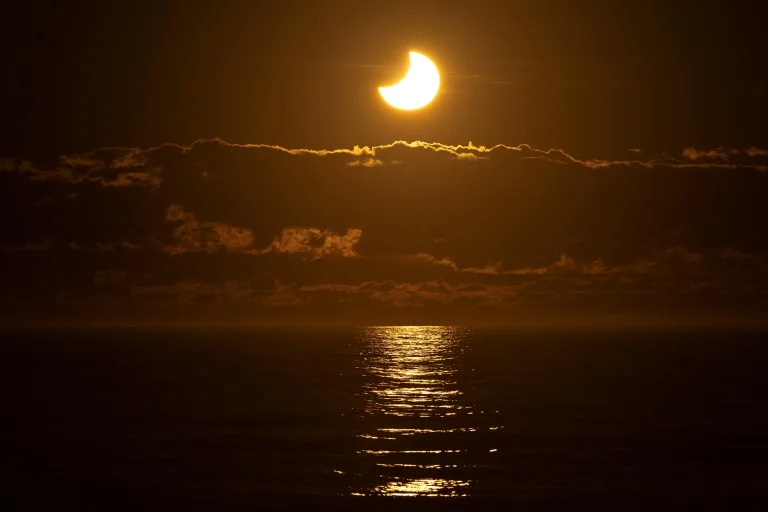
The Earth may not be engulfed by the expanding fireball of the dying Sun, which has long been assumed to be our home planet's ultimate fate, according to scientists.
Don't worry: this is not expected to happen for another five billion years, long after all life on Earth has been wiped out.
When the Sun burns through all of the hydrogen in its core, it will go through two immense expansion phases: first becoming a red giant, then, when its helium is spent, an "AGB" star.
This fiery death will bring about some significant changes back here on Earth.
As the Sun grows, increasing gravitational forces will pull the Earth towards it.
For the Earth and the Moon, this force creates the push and pull of the tides in our oceans. The energy from these tides, which dissipates at the bottom of the ocean, slows Earth's rotation and gradually pushes the Moon away from us.
As the Sun expands and its blistering surface approaches Earth, intense tidal waves will stir within the star. When they dissipate, it will pull Earth into its doomed embrace.
However, the growing Sun will also lose a lot of its mass due to stellar wind, which pushes our planet further away.
"Earth's fate depends on a delicate balance between these two effects," explained Mats Esseldeurs, the lead author of a study published in the journal Astronomy & Astrophysics on Friday.
"If tidal interactions predominate, Earth is engulfed by the Sun. If the Sun's mass loss predominates, Earth escapes into an orbit larger than the radius of its star," the astrophysicist at Belgium's University of Leuven said in a statement.
Until now, scientists had favoured the first hypothesis.
- Catching some Sun -
However their calculations relied on relatively simple descriptions of tidal dissipation within giant stars.
Advances made in modelling these tides over the last 15 years have enabled the study's authors to show that "the dissipation is lower than previously expected", Stephane Mathis, an astrophysicist at the CEA Paris-Saclay centre in France, told AFP.
To estimate how much mass the Sun could lose, the team focused in particular on a nearby star called L2 Puppis that is like the Sun's "old cousin", the study's co-author said.
"A better understanding of tidal physics and the most advanced constraints we have on mass loss allow us to say that -- in the current state of knowledge -- Earth could move away from the Sun, contrary to what was predicted before," Mathis said.
According to the new modelling, Mars also escapes a death spiral into the Sun.
But the two planets closest to the Sun, Mercury and Venus, are not so lucky. They will be inexorably swallowed by the expanding fireball.
After all this, the Sun will eventually become an extremely dense star called a white dwarf.
No longer capable of fusion reactions, it will slowly become dimmer and cooler over time.