News Flash
DHAKA, Jan 16, 2026 (BSS) - Eminent citizens of the country have remembered three-time former Prime Minister Begum Khaleda Zia with deep respect, saying that to build the country, people must advance on the path shown by her.
They said that Khaleda Zia, who endured prolonged political oppression and extreme repression, did not spread animosity even after the mass uprising of 2024. Instead, she called for unity, mobilizing the strength of youth, and building a knowledge-based country and nation. Citizens urged all to move forward by embracing the path she had shown.
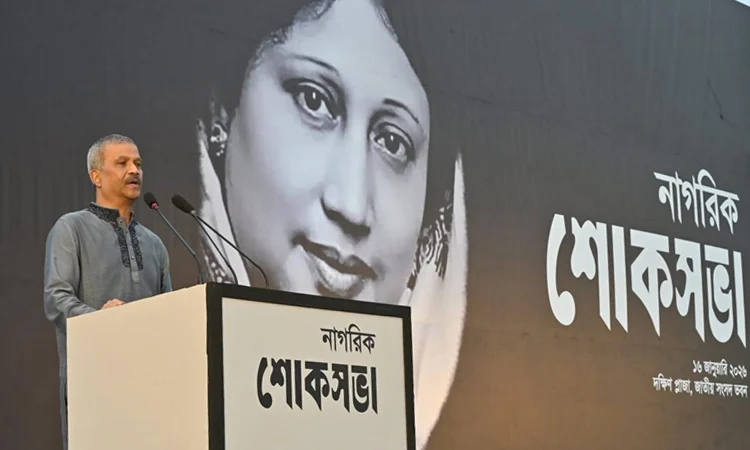
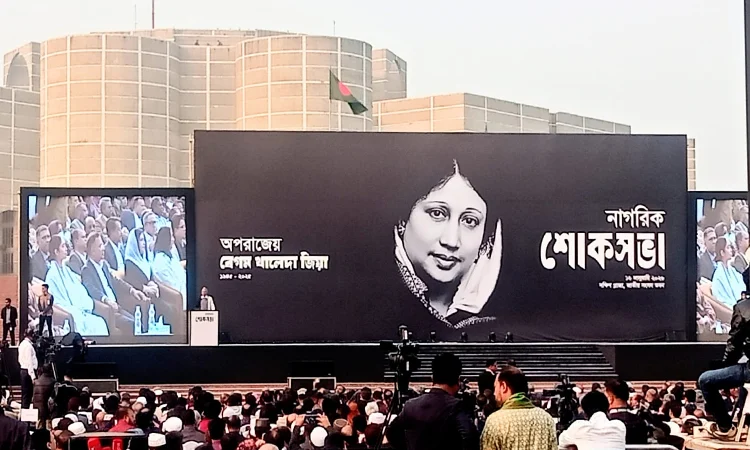
The speakers made these observations at a citizens' condolence meeting titled "Invincible Begum Khaleda Zia", held this afternoon at the South Plaza of the National Parliament Building in remembrance of Begum Khaleda Zia.
At the condolence meeting, eminent personalities discussed Begum Khaleda Zia's long political life, her uncompromising role in Bangladesh's democratic movement, and her contributions to state governance. They highlighted different aspects of the late leader's political wisdom, sacrifices, and leadership qualities, recalling how she rose from a homemaker to become the Prime Minister of the country.
Top political leaders, diplomats, journalists, development workers, academics, researchers, editors, business leaders, and people from various professions attended the condolence meeting.
The meeting concluded at 5:30 pm with prayers and supplications seeking forgiveness for the soul of Begum Khaleda Zia.
Earlier, at 2:30 pm, BNP Chairman Tarique Rahman, along with his family, attended the citizens' condolence meeting at the South Plaza of the National Parliament Building. He was accompanied by his wife Zubaida Rahman, daughter Zaima Rahman, Khaleda Zia's younger son Arafat Rahman Koko's wife Sharmila Rahman, and other family members.
After Tarique Rahman arrived at the venue and before the formal programme began, a documentary on Khaleda Zia was screened. At 3:05 pm, the condolence meeting formally began with recitation from the Holy Quran. Saleh Uddin, Executive Editor of Daily Ittefaq, presented the eulogy.
Subsequently, speeches were delivered one by one by writer Faham Abdus Salam; President of the Puja Udjapan Parishad Basudeb Dhar; Khaleda Zia's physician Dr F M Siddiqui; former Special Assistant to the Chief Adviser of the Caretaker Government Debashish Roy; Editor of Amar Desh Mahmudur Rahman; President of the International Chamber of Commerce Bangladesh (ICCB) Mahbubur Rahman; Distinguished Fellow of CPD Dr Debapriya Bhattacharya; senior editor Shafiq Rehman; writer and researcher Mohiuddin Ahmed; Editor of The Daily Star Mahfuz Anam; President of DPI Abdus Sattar Dulal; former diplomat Anwar Hashim; ICC Bangladesh Executive Member and CEO of Transcom Group Simeen Rahman; Chairman of the University Grants Commission (UGC) S M A Faiz; writer and researcher Rashed Al Mahmud Titumir; Law, Justice and Parliamentary Affairs Adviser Asif Nazrul; economist Professor Mahbub Ullah; and former Chief Justice Syed JR Modassir Hossain.
In his presidential address, former Chief Justice Syed JR Modassir Hossain said Begum Khaleda Zia was not only the leader of a political party but also a repeatedly elected Prime Minister and an important stakeholder in the democratic era of Bangladesh. In her personal life, he said, she was extraordinarily strong-willed and demonstrated patience and self-respect even during political struggles and difficult times.
He expressed sadness and astonishment over her treatment, stating that Begum Khaleda Zia had been imprisoned for a long time in a vindictive case, which he described as a painful chapter in the country's political history.
"She had said-not destruction, not revenge, not vengeance; we must build a peaceful society with love," he said.
Modassir Hossain added that he firmly believed this statement was not merely a political narrative. In his judgment, she was a discerning and true stateswoman.
He urged the government to confer the highest state honor upon Begum Khaleda Zia.
Economist and political analyst Professor Mahbub Ullah said Khaleda Zia loved the country deeply-its land and its water-and fought for its interests. Recalling the initiative by the Indian government to build the Tipaimukh Dam, he said she had instructed them to organize a large-scale seminar to raise public awareness and voice national demands.
He said that while remembering her, people would forever remember three of her statements: "We have friends abroad, not masters"; "the flag of independence is in our hands, shackles are in theirs"; and "I have no address abroad-the country is my final address." He added that if her party and the country embraced these principles, they would be saved.
"With the death of Begum Khaleda Zia, time has not died, history has not died," he said, adding that the driving force of future history in this land would be Khaleda Zia and her ideals.
Law Adviser Asif Nazrul said people could freely express their love and respect for Begum Zia, recalling what he described as a bizarre trial she had faced. He cited an instance where, upon hearing a lawyer's argument, she exclaimed in astonishment, "What! Have I embezzled an orphan's money?"-which, he said, was later recorded by the judge as an admission of guilt.
He said he went door to door and made phone calls seeking statements against the trial, but when more than four people did not agree, the statement could not be published in newspapers. He also said that when Khaleda Zia was in critical condition, he pleaded with many people to send her abroad for treatment, but although many may have wanted to, they did not dare.
"When she was alive, I used to say at various events, 'If Begum Zia is well, Bangladesh will be well,'" he said. "I believe she is certainly well now. But is Bangladesh well? For Bangladesh to be well, Begum Zia must be internalized."
Editor of The Daily Star Mahfuz Anam said that when the previous government oppressed Khaleda Zia in various ways and placed her under house arrest, she heartbreakingly did not receive proper treatment. He said the message she gave on August 7, 2024, reflected her magnanimity against destruction and vengeance.
If the nation could wholeheartedly embrace her call to build a knowledge-based country, he said, the future of Bangladesh would be different.
New Age Editor Nurul Kabir said that through her death, Khaleda Zia had proven she was not only the leader of the BNP but had truly become the leader of the people and the country, as demonstrated by the participation of hundreds of thousands of people in her janaza, regardless of party affiliation.
He said that despite her political successes, the adversities she faced, and the hardships endured by her family, she never publicly expressed pain or resentment. This restraint, sense of proportion, and self-respect in politics, he said, were extremely important in today's intolerant Bangladesh and would ensure her unique place in history.
Amar Desh Editor Mahmudur Rahman said the political legacy and the flag of struggle of Shaheed President Ziaur Rahman and stateswoman Begum Khaleda Zia had now been entrusted to Tarique Rahman-a matter of pride as well as deep responsibility and challenge.
He said that in the 55-year history of Bangladesh, only two leaders had been born whose equals were hard to match, and when such leaders are parents, the responsibility for their child becomes even more difficult.
Eminent economist Dr Debapriya Bhattacharya said Khaleda Zia had three great qualities: she listened, she knew how to ask questions, and she made decisions considering the country's interests and global importance.
He said that at the current juncture, her presence, advice, and guidance were perhaps most needed, adding that she would have wanted today's challenges to be faced collectively, with integrity and love for the motherland. He noted that her life was multidimensional and said he had been fortunate to discuss policy matters with her four times during her two tenures.
Referring to Khaleda Zia's message of moving away from vengeance, writer and researcher Mohiuddin Ahmed said she had led her party out of devastation during her rise, governed with authority, and later became a victim of persecution after 2007. Her final phase, he said, created sympathy among people.
He said her last speech conveyed the message of rejecting vengeance, adding, "To give light to others, one must become a candle oneself."
Editor of Jai Jai Din Shafiq Rehman called for the February 12 election to be held by all means. He said the government had promised a festive atmosphere and urged the police to play a positive role so that people could go to polling centers enthusiastically and vote. Transforming grief into strength by voting, he said, was the true way to honor Khaleda Zia.
ICCB President Mahbubur Rahman said that during Khaleda Zia's tenure, infrastructure development, rule of law, and policies ensuring investment security and certainty helped place the economy on a stronger foundation. He also highlighted her initiatives in education and skills development.
He said the assessment of a statesperson was not limited to their time in power, noting that history also remembers how Khaleda Zia handled crises while out of power and maintained her relationship with the country and politics.
Professor Ali Riaz and Special Assistant to the Chief Adviser Manir Haider also attended the meeting.
BNP Secretary General Mirza Fakhrul Islam Alamgir, Standing Committee members Nazrul Islam Khan, Abdul Moeen Khan, Mirza Abbas, Selima Rahman, Salahuddin Ahmed, A Z M Zahid Hossain, Security Adviser Major General (Retd) Fazle Elahi Akbar, Chairman's Adviser Mahdi Amin, and other senior leaders were present.
Members of the army, police, Rapid Action Battalion (RAB), Border Guard Bangladesh (BGB), Coast Guard, Ansar, and various law enforcement and intelligence agencies were deployed to ensure security at the venue. Security was strengthened as the crowd increased, while leaders and activists of various BNP wings and affiliated organizations helped maintain order at the event.