News Flash
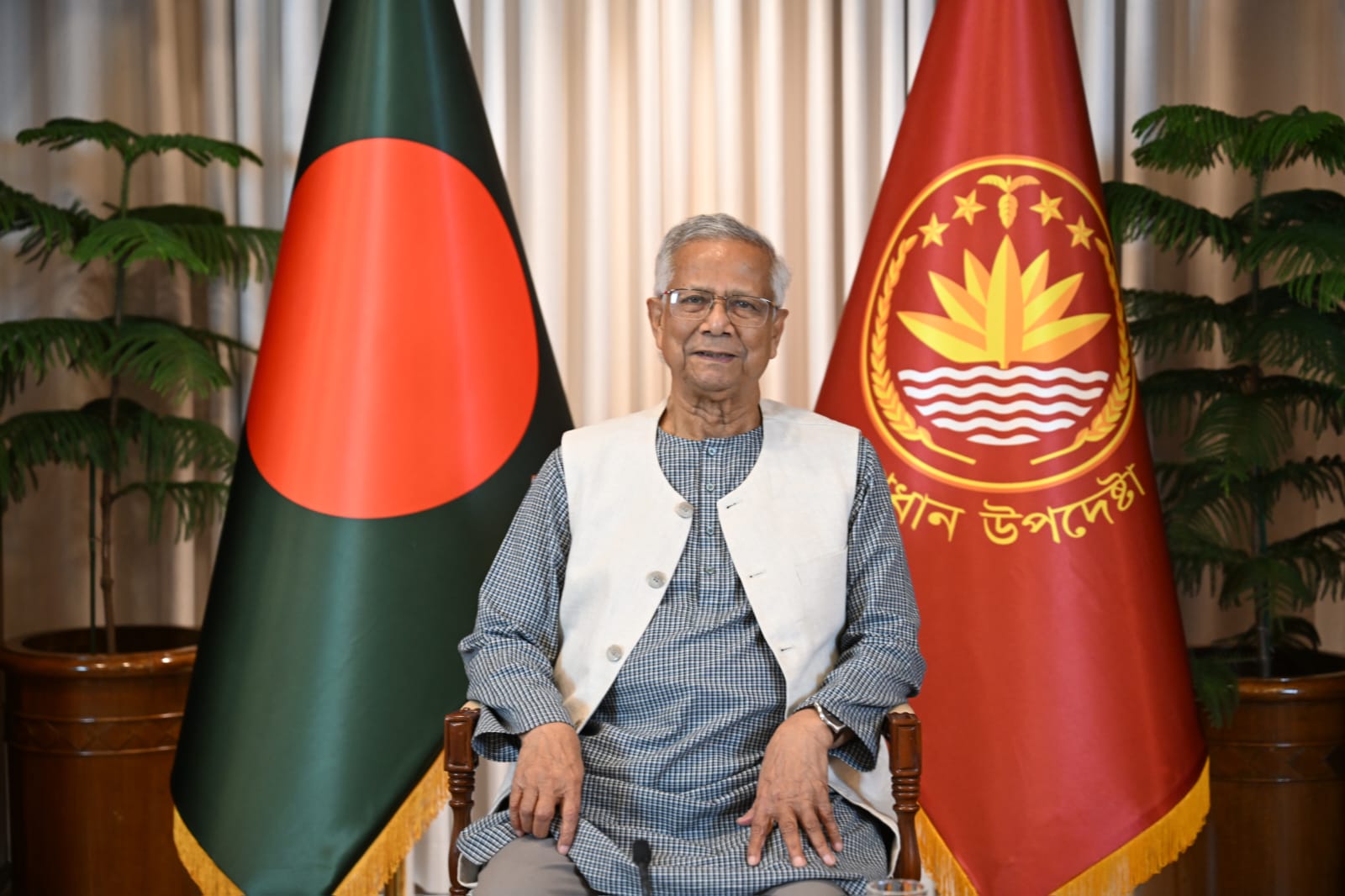
DHAKA, Feb 16, 2026 (BSS) - Highlighting the interim government's initiatives to ensure democratic rights and values over the last 18 months, Chief Adviser Professor Muhammad Yunus has called upon everyone to continue the struggle to build a just, humane and democratic Bangladesh.
"I call upon everyone, regardless of party, creed, religion, caste and gender to continue the struggle to build a just, humane, and democratic Bangladesh. With this appeal, I bid farewell with great optimism," he said in his farewell address to the nation tonight.
Urging all to build a Bangladesh where possibilities are limitless and dreams have no boundaries, the Chief Adviser said over the last 18 months, the people of this country have gradually started to practice democracy, a welfare-oriented governance, freedom of speech, the ability to question and criticize power, and the ability to hold it accountable.
"The people's rights have been ensured by organizing elections in a festive atmosphere. Let this trend not be lost in any way," he added.
Prof Yunus expressed confidence that the people of Bangladesh and all political stakeholders will protect and enrich this democratic trajectory through steel-strong unity in the days ahead.
On matters of rights, independence and sovereignty, he urged steadfast commitment to building a beautiful Bangladesh for the next generation.
"On the eve of my departure from my duties, I express my heartfelt gratitude to all of you -- the children, teenagers, young people, students, men and women, young and old -- of the country. Please pray for me," the Chief Adviser said.
At the outset of his speech, Prof Yunus congratulated everyone of the country over the successful completion of a festive, participatory and peaceful national election after 17 long years.
Through this election, he said, the people, voters, political parties, candidates, election-related institutions and law enforcement agencies collectively created a commendable precedent.
"This election will be an excellent example of how Bangladesh's elections should be in the future," the Chief Adviser added.
Noting that this election was not just a process of transferring power, he said, "It is the beginning of a new journey for Bangladesh's democratic system; the birth of a new Bangladesh".
Prof Yunus expressed his deep respect and gratitude to those who were behind this achievement-the young protesters who took to the streets in July, 2024.
He thanked the country's people, voters, political parties, candidates, election-related institutions, law enforcement agencies, armed forces and government officials for their sincere cooperation to make the election successful.
The Chief Adviser congratulated all candidates who contested the polls, including the winners and losers.
Recalling the event of August 5, 2024, when the country's people from all walks of life had breathed a sigh of relief from everywhere after ousting the 16 year long fascist regime, he said the student leaders of the movement had invited him to lead the government at that turbulent time.
"After faithfully fulfilling the duties entrusted to me for the past 18 months, I have come to bid you farewell today as the Chief Advisor to the interim government on the eve of handing over the responsibility to an elected government," Prof Yunus said.
Following the 2024 July Uprising, he said he was invited to join the interim government as its head a time when the country was in a deep political, economic, institutional and humanitarian crisis.
"People had lost faith in the state apparatus, democracy was in shambles, and the future was uncertain. I was called upon at that critical time-with one goal in mind. I was given three responsibilities- reform justice and elections- to return Bangladesh to normal situation," the Chief Adviser added.
Urging the people to assess the government efforts where it was successful in fulfilling its duties, he said, "There was no shortage of our efforts".
Highlighting the government's reform initiative, Prof Yunus said his government has formulated about 130 new laws and amendments and issued about 600 executive orders, about 84 percent of which have already been implemented.
He said these reforms have consolidated civil rights, strengthened the judiciary, and ensured that the culture of disappearances, murder, and extrajudicial killings never returns.
Noting the government's steps to ensure safety and security for the women and children, the Chief Adviser said his government has brought amendments to the Prevention of Sexual Harassment at the Workplace and Educational Institutions Ordinance and the Domestic Violence Prevention Ordinance and the Prevention of Oppression against Women and Children Act.
These new laws have paved the way for preventing harassment and ensuring protection of women in the workplace and educational institutions, he added.
Recalling the armed forces' patience, professionalism, and sense of responsibility to bring the country back to normalcy gradually during the turbulent post-uprising period, Prof Yunus thanked every member of the forces.
About the trial of the July massacre, he said verdicts in several cases have already been announced by the International Crimes Tribunal while the judicial process of some cases is at the final stage.
"We hope that the judicial process will proceed with great impartiality and transparency in the coming days as well," the Chief Adviser said.
Terming the July National Charter a biggest achievement of the interim government, he said if the July National Charter is implemented, the paths to the return of fascism will be closed forever.
"I hope it will be implemented within the stipulated time frame," Prof Yunus added.
About the introduction of postal ballot to include the expatriate Bangladeshis to the democratic process, he expressed hope that many more expatriates will be able to participate safely in this process in the future.
Noting that when his government took office, the economy was in turmoil, the banking system was collapsing, money laundering was rampant, the Chief Adviser said that his government brought in structural reforms in revenue management, tax policy, currency management and the financial sector and brought the country economy in a positive trend.
To address the price hike of essentials, he said his government increased supply to control the prices of essential commodities while TCB activities have been expanded.
"Strict measures have been taken against hoarding. As a result, food inflation has decreased significantly," Prof Yunus added.
Considering labor rights as part of human rights, the Chief Adviser said important conventions of the International Labour Organization have been ratified-which will ensure the safety and dignity of workers in the workplace.
He also said that a groundbreaking new labor law has been enacted to this end.
Terming the expatriates as the lifeline of the country's economy, Prof Yunus said laws have been amended while steps haven taken to give legal assistance abroad and skills development projects have been adopted for their protection and welfare.
He said a series of strategic projects, including the largest European investment, have been advanced through radical reforms in port management and investment structures and added that new authorities have been formed to develop deep-sea ports, fisheries and modern townships to harness the potential of the blue economy.
About the foreign policy, he said, "We have been able to firmly restore the three fundamental foundations of Bangladesh's foreign policy - sovereignty, national interests and the dignity of the country".
Bangladesh is no longer dependent on a knee-jerk foreign policy or the instructions and advice of other countries, he said, adding, "Today's Bangladesh is confident, active and responsible in protecting its independent interests".
"We are committed to building relations with all countries of the world based on mutual respect and interests. Bangladesh has established itself today as a state capable of taking necessary strategic decisions for the future while maintaining balance," the Chief Adviser said.
About the Rohingya crisis, he said this issue has posed a serious and long-term strain on Bangladesh's national security, regional stability and economy.
Unfortunately, for a long time, no effective and coordinated international initiative was visible to resolve this crisis, Prof Yunus said, adding, "Since taking office, we have been able to bring this issue, which was moribund in the international arena, back to the center of global attention".
About defence capacity, he said during the long fascist regime, the issue of the capacity and modernization of the armed forces of Bangladesh was systematically neglected.
"We have been able to initiate a fundamental change in that situation within a short period of time. Since assuming office, the current government has prioritized increasing the capacity of the armed forces, modernizing them, and making them suitable for effectively confronting any kind of aggression," the Chief Adviser said.
Noting that the country's youths have infinite potential, he said, "If we take appropriate steps to meet the global demand, then Japan, Korea, the Middle East, Europe, North America, and everyone else will want to utilize the labor, talent, and creativity of Bangladesh's youth. We can become a reliable and skilled manpower supplier of choice for them".
Referring to the recent reciprocal tariff agreement signed between Bangladesh and the USA, Prof Yunus said this agreement is not just a commercial benefit; it will serve as a strategic foundation for strengthening Bangladesh's economy, employment, industrialization, and international diplomatic position in the long term.
"As a result of this agreement, the reciprocal tariff applicable to Bangladesh in the US market has been reduced from 37 percent to 19 percent," he added.
Noting that the Economic Partnership Agreement (EPA) signed between Bangladesh and Japan is a historic and strategic step towards making Bangladesh's economic future sustainable, diversified and technology-driven, Prof Yunus said one of the key benefits of this partnership is the diversification of production and exports.
As a result of cooperation with Japan, he said Bangladesh will be able to gradually join the automobile parts, electronics, railway equipment, green technology and high-value industrial products.
"This will reduce our risks and strengthen Bangladesh's position in the global market. The industrialized countries of the world will invest in our country just to take advantage of duty-free exports to Japan," the Chief Adviser said.
Referring to relations with China, he said Bangladesh has deepened its development cooperation with China.
Recalling his meeting with Chinese President Xi Jinping in Beijing last March, Prof Yunus said that both sides expressed their determination to elevate the strategic partnership between the two countries to a new level.
Stressing on eliminating corruption and fraud, he said in the past, state management encouraged unlimited corruption, dishonesty, irregularities and fraud.
"That culture held us back, undermined our credibility. The new Bangladesh must move away from that path. We must be committed to following the rules, keeping promises, maintaining standards, making every level of the state corruption-free, and ensuring transparency and accountability," the Chief Adviser said.
Referring to the post uprising period when the interim government assumed office, Prof Yunus said, "We did not begin from zero, but from a minus position. We have cleared the rubble, established institutions, and then embarked on the path of reform".
"Today, the interim government is leaving. But the trend of democracy, accountability, freedom of speech, and the exercise of rights that has begun-may it never stop.
Even though the government is relinquishing state responsibility, he said, the broader responsibility of building a new Bangladesh rests with everyone.
"It is our collective duty to ensure that the country truly flourishes as a democracy," the Chief Adviser said.
"The July mass uprising has opened this door for us. If we can keep our dreams, aspirations and energy alive, no one can stop the progress of Bangladesh," he added.
Paying tribute to those who lost their lives during the uprising, those who lost limbs and are living in hardship, those whose bodies were burned, those whose remains have not yet been found, and those who narrowly survived, Prof Yunus said the nation must never forget their sacrifices.
"Every state decision should be taken with their memory in mind, and future generations must be taught how to hold the powerful accountable," he added.
To preserve the historical lessons of how power can strip individuals of humanity, the Chief Adviser said that the residence- Ganabhaban- of the fugitive former Prime Minister Sheikh Hasina has been established as the National July Memorial Museum.
"There are preserved real samples of your memories. When the museum will be open to the public, wherever you are - whether in the country or abroad - I request you to come and spend some time in the museum with your family," Prof Yunus said.