News Flash
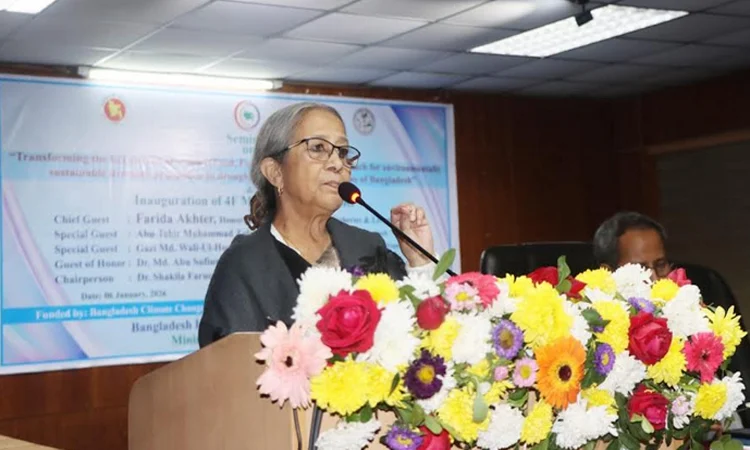
DHAKA, Jan 6, 2026 (BSS) - Fisheries and Livestock Adviser Farida Akhter today said Bangladesh wants to set an example in cutting methane emissions.
“Methane and other greenhouse gases are emitted in some sectors at local level — especially in agriculture and livestock. However, research is on in the country to control and reduce emissions in these sectors,” she said.
The livestock adviser made the remarks while speaking at a seminar and opening of replica of the '4F Model' under the project titled "Sustainable Climate Resilient Livestock Development in Drought-Prone and Coastal Regions of Bangladesh through Implementation of IoT Based 4F Model".
The seminar was arranged at Bangladesh Livestock Research Institute (BLRI) in Savar this afternoon.
Speaking as the chief guest, Farida said if the methods developed through research are implemented at the field level, Bangladesh will be able to prove in the international arena that despite being a low-emitting country, Bangladesh is taking effective steps to responsibly cut methane emissions.
“And this will also be an example for rich countries,” she added.
The fisheries and livestock adviser said the BLRI has undertaken an important project based on the '4F Model' with the support of the Climate Trust Fund.
Through this project, she said, it will be possible to produce animal feed, food, fuel (biogas) and biofertilizer from grass, which is implementable at the small hold farmer level.
On the one hand, this will help reduce methane emissions, and the living standard of farmers will improve, Farida said.
She said many countries want to export meat to Bangladesh at low prices. “When I went abroad, I saw that the price of their domestic meat is not low. They actually want to export the surplus meat of their livestock industry to our country. There are various risks in importing meat from abroad,” she added.
The adviser said if meats are imported, local farmers will be affected and there may be health risks too.
Responding to a question, she said there is a need for fundamental and policy changes in the livestock sector.
“Various plans have already been taken in this sector…the benefits will be visible in the near future,” the adviser said.
Gazi Md Wali-ul-Haq, Managing Director (Additional Secretary) of Bangladesh Climate Change Trust, was present as a special guest at the seminar, while Dr. Md. Abu Sufian, Director General of the Department of Livestock Services, as the guest of honour.
Dr. Shakila Faruque, BLRI Director General (Interim Responsibility), presided over the seminar.
Representatives from the Ministry of Fisheries and Livestock, the Department of Livestock Services, various universities, farm and poultry production experts, farmers, entrepreneurs, scientists and officials of BLRI and media representatives participated in the seminar.