News Flash
By Motahar Hossain
DHAKA, June 21, 2026 (BSS) – Free healthcare facilities are no more a distant dream for the capital’s thousands of transport workers as health camps at the city’s key locations have started providing medical services directly to this marginalized group.
Irregular meals, inadequate rest and demanding work schedules often lead to various health complications, yet many transport workers are unable to seek medical attention due to financial constraints and lack of time.
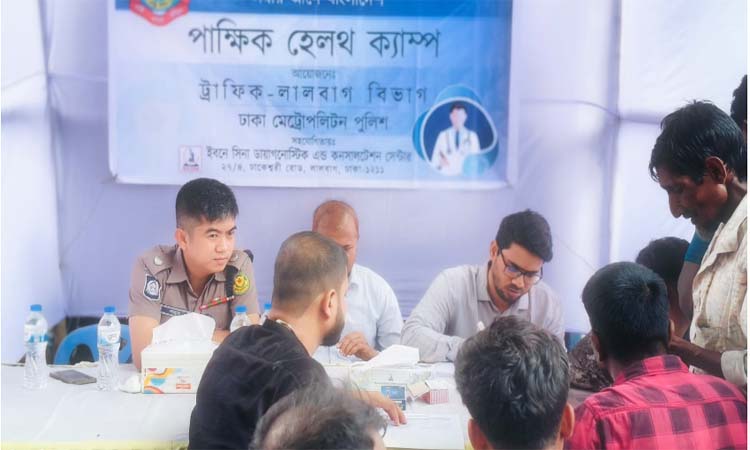
To address this issue, the Traffic Division of the Dhaka Metropolitan Police (DMP) has launched fortnightly health camps at key locations across the capital to provide free medical services directly to transport workers who spend long hours on the roads every day.
Implemented with support from several private hospitals and diagnostic centres, the initiative offers a wide range of facilities including free health screenings, medical consultations and prescriptions.
Since its launch on May 16 this year, the programme has so far provided healthcare services to 1,121 transport workers.
DMP officials said transport workers are increasingly vulnerable to health problems caused by prolonged working hours, irregular lifestyles and occupational stress.
Such conditions not only affect their well-being but can also pose risks to road safety by increasing the likelihood of traffic accidents.
Recognising these concerns, the Traffic Division introduced the health camps as part of a broader social responsibility initiative aimed at promoting both public health and safer roads.
The programme was formally inaugurated in front of the Mahakhali Bus Terminal and is now being conducted regularly at multiple locations under different traffic divisions across Dhaka.
The camps provide blood pressure monitoring, blood glucose testing, basic eye examinations and other primary health assessments. Participants also receive medical advice and necessary prescriptions from volunteer physicians.
According to DMP sources, health camps are currently being operated at Gabtoli Bus Terminal, Mirpur-10 roundabout, Technical Crossing Traffic Police Box, Dhakeshwari area, Fulbaria Bus Stand, Rampura Police Box area, Kamarpara Traffic Police Box, House Building Traffic Police Box, Jasimuddin Police Box, Airport roundabout, Kakrail and the Baldha Garden area.
In addition, regular camps are being held at the Mahakhali Bus Terminal under the Gulshan Traffic Division.
Of the 1,121 transport workers who have received services so far, 242 were treated under the Mirpur Traffic Division, 225 under Wari, 150 under Tejgaon, 147 under Lalbagh, 124 under Gulshan, 91 under Uttara, 82 under Motijheel and 60 under Ramna Traffic Division.
Medical professionals involved in the programme said many drivers and helpers suffer from hypertension, diabetes, respiratory illnesses, vision impairment and musculoskeletal disorders linked to prolonged sitting and physically demanding work conditions.
They noted that most of these conditions can be managed effectively through regular health monitoring and timely treatment.
However, many transport workers remain outside the healthcare system due to their demanding schedules and limited financial means.
During a recent health camp held at seven key locations in the capital on June 13, transport workers were seen taking advantage of the services by checking their blood pressure and blood sugar levels and consulting physicians about various health concerns.
Bus driver Din Islam welcomed the initiative, saying it had helped identify a previously undiagnosed health condition.
“We are happy with this initiative. We are poor people and usually do not visit doctors unless we become seriously ill.
I did not know I had diabetes until the test at the camp revealed it. Many drivers and helpers like me are benefiting from this service,” he said.
Another beneficiary, transport helper Usman Gani, said the programme had enabled him to receive medical attention that would otherwise have been difficult to afford.
“My work requires me to stand for long hours, which causes pain in different parts of my body. I cannot usually afford to see a doctor. Here I received treatment free of cost, and the doctors were very supportive,” he said.
Dr. Mohammad Faruk Hossain of Omega Hospital and Diagnostic Centre said two physicians typically treat between 50 and 70 patients during a single camp session.
He identified lower back pain as the most common complaint among transport workers, attributing it to prolonged periods of sitting while driving.
“Continuous pressure on the spine can eventually lead to degenerative problems. Many drivers also report frequent headaches due to extended working hours, insufficient sleep and inadequate rest,” he said.
He added that cases of scabies and other skin diseases had also been detected during examinations.
Dr. Mohammad Amuddin of Ibn Sina Diagnostic Center said common health complaints among transport workers included coughs, colds, fatigue and sleep disorders, particularly among smokers.
Body aches, limb pain and skin diseases were also prevalent, while hypertension and diabetes were observed in a smaller number of cases.
He further noted that some elderly drivers were found to have vision problems, a condition that could significantly increase the risk of road accidents if left untreated.
DMP Additional Commissioner (Traffic) Md. Anisur Rahman said the initiative was designed to bring healthcare services directly to transport workers who often struggle to prioritise their own health.
“Various studies indicate that professional drivers are more susceptible to hypertension, diabetes and other chronic health conditions. Many also experience vision-related problems.
If a driver operates a vehicle while suffering from serious health issues, it can lead to accidents,” he said.
“Since many drivers cannot find the time to visit healthcare facilities, we decided to bring doctors to them. With support from government and private healthcare institutions, we are delivering healthcare services where they are needed most,” he added.
Rahman said the programme currently operates without a dedicated budget and relies largely on the voluntary participation of medical professionals.
“This is fundamentally a humanitarian initiative and is currently being implemented as a pilot project.
We plan to expand its scope in the future. With support from the Health Ministry and other relevant stakeholders, we believe the programme can be extended to benefit many more transport workers,” he added.