News Flash
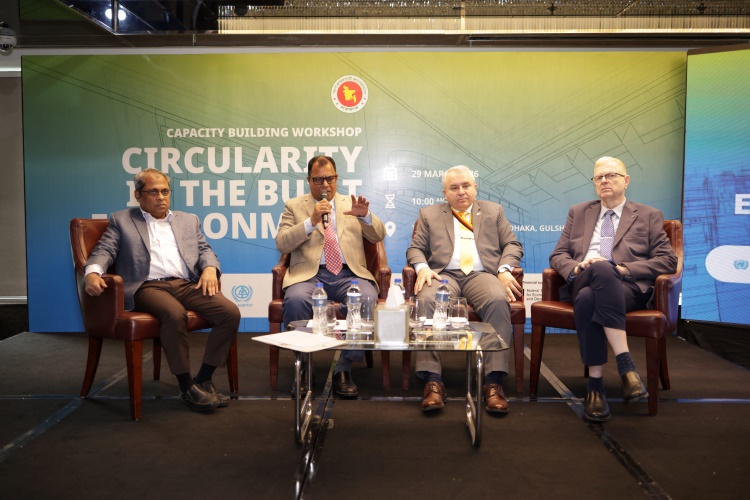
DHAKA, March 29, 2026 (BSS) - Speakers at a workshop in the capital today
stressed that adopting circular economy principles in the construction sector
is essential for ensuring sustainable development, reducing carbon emissions
and improving resource efficiency in Bangladesh.
They said integrating circularity in the built environment-through reuse of
materials, recycling of construction waste and efficient design-can play a
key role in building climate-resilient infrastructure.
The observations came at a training workshop on "Circularity in the Built
Environment," organised by the Ministry of Housing and Public Works in
collaboration with the United Nations Environment Programme, United Nations
Office for Project Services and UN-Habitat.
The initiative is part of a project titled "Transforming the Built
Environment through Sustainable Materials in Bangladesh," funded by the
German Federal Ministry for Economic Cooperation and Development.
Speakers said Bangladesh's rapid urbanisation and infrastructure expansion
are putting increasing pressure on natural resources, making circular
approaches both timely and necessary.
They emphasised that adopting circular practices would not only reduce
environmental impact but also support long-term economic sustainability in
the construction sector.
Addressing the session, Additional Secretary of the ministry Md Sarwar Alam
and other speakers highlighted the need for coordinated efforts among
government agencies, development partners and the private sector to implement
circular solutions.
They also stressed the importance of strengthening technical capacity, policy
support and awareness to scale up circular practices across the sector.
The workshop included keynote presentations, technical sessions and group
discussions focusing on construction and demolition waste management,
circular design strategies, resource optimisation and sustainable business
models.
Speakers expressed hope that such initiatives would help Bangladesh move
towards low-carbon construction and align the sector with national climate
commitments, including the upcoming Nationally Determined Contributions
(NDCs).