News Flash
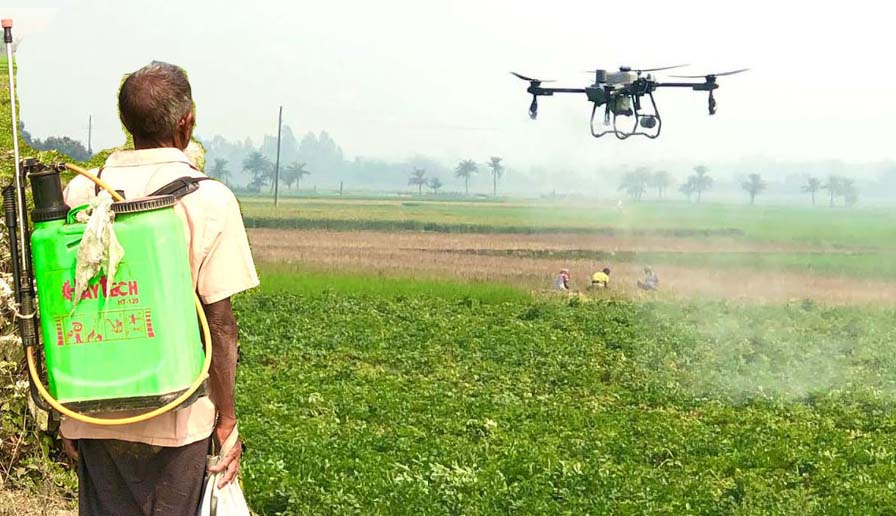
RAJSHAHI, March 12, 2026 (BSS) - Modern technology is gradually transforming Bangladesh's agriculture sector, with farmers beginning to adopt advanced tools to save time, labor and costs.
In a notable example, pesticides were sprayed using drone technology in crop fields at Dampura village under Rasulpur Union in Niamatpur upazila of Naogaon district last Wednesday.
The initiative was taken by agricultural entrepreneur Obaidur Rahman Jewel, who applied pesticides in his dragon fruit orchard, mango gardens and potato fields using a drone.
The use of such modern technology surprised many farmers in the remote area, who gathered to witness the demonstration of drone-based pesticide spraying in the fields.
Local farmer Anisur Rahman Budhu said he was returning home after manually spraying pesticides in his field when he noticed a drone flying over a nearby potato field and spraying chemicals.
"I had only seen such technology on television before. Seeing it happening in our village fields amazed me," he said.
Budhu said he became exhausted after spraying pesticides on just 10 kathas of land and felt dizzy from the chemical smell.
"Farmers face health risks while spraying pesticides manually. If drones are used, farmers like us can avoid these dangers," he said, adding that many farmers often fall sick due to exposure to pesticide fumes.
Entrepreneur Obaidur Rahman Jewel previously worked as a mathematics teacher at a government college. Alongside teaching, he established an agricultural farm in Dampura village.
After analysing the soil in the area, he developed a five-acre dragon fruit orchard in the village at an early stage of dragon fruit cultivation in the country. He also owns several mango orchards of different varieties.
This year, he has experimentally cultivated potatoes on four acres of sandy land in Niamatpur and believes the crop has strong potential in the region, similar to his success with dragon fruit farming.
Jewel said he was inspired to use drones after observing their application in agriculture in developed countries. "I wanted to introduce modern technology in local farming and encourage farmers to adopt innovative methods," he added.
According to him, drone technology reduced pesticide use by nearly half while cutting labour costs to about one-fourth. He believes wider use of such technologies could significantly boost the country's agricultural productivity if supported by government initiatives.
A Dhaka-based organization, Muspana, is currently conducting experimental research on the use of agricultural technology.
At the invitation of Jewel, the organization conducted drone-based pesticide spraying in potato fields, dragon fruit orchards and mango gardens in the area.
The initiative is part of the "Muspana AgroFly" project, managed by BUET-graduate engineers Tanvir, the assistant general manager of the project, and Habib.
Engineer Tanvir said drones are used to apply pesticides and fertilizers precisely, ensuring there is no wastage while also reducing health risks for farmers who would otherwise spray chemicals manually.
Niamatpur Upazila Agriculture Officer Rafiqul Islam said drone-based spraying could be beneficial for both farmers and the agriculture sector.
"If the government provides incentives for modern agricultural technologies, their use will expand and become more accessible to farmers," he added.