News Flash
RAJSHAHI, March 12, 2026 (BSS) - Rajshahi silk, once famed nationwide for its rich heritage, fine texture and elegant craftsmanship, is increasingly losing its traditional identity as most fabrics sold under the name now rely on imported yarn rather than locally produced silk.
While Rajshahi silk historically symbolized culture and aristocracy, industry insiders say only a small portion of the products currently available in the city are made from genuine local silk. Most factories now use yarn imported from China and India, leaving the government-run silk factory as the only major source producing fabric directly from silkworm cocoons.
People involved in the sector say silk production involves five stages beginning with silkworm cocoons. In the BSCIC industrial area of Rajshahi, around 20 factories operate, but most weave fabrics using imported yarn.
Silk yarn produced locally from cocoons comes mainly from the Rajshahi Silk Factory operated under the Bangladesh Sericulture Development Board. However, many private showrooms market their products under the name of Rajshahi silk despite using imported yarn.
According to the Bangladesh Silk Industry Owners Association, there are currently 16 mulberry nurseries across the country for producing silkworm cocoons-11 run by the government and five privately operated. These nurseries produce about four tonnes of fine silk yarn and around 40 tonnes of waste yarn annually, while the national demand stands at about 400 tonnes.
As a result, nearly 350 tonnes of yarn must be imported from China and India each year to sustain fabric production in Rajshahi.
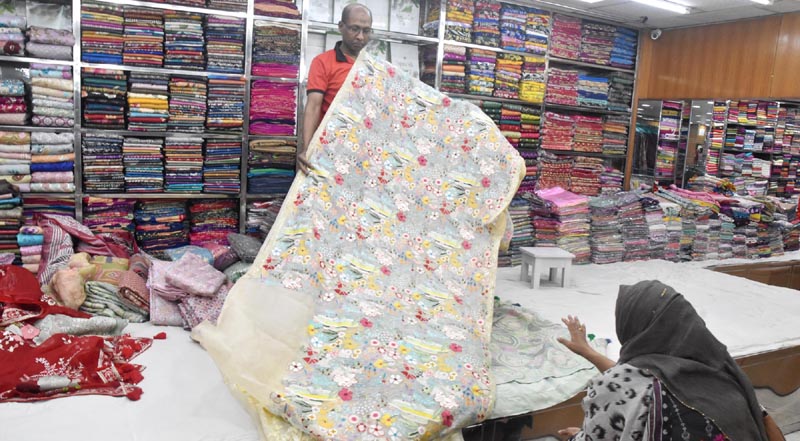
Although silk garments are relatively expensive, markets in Rajshahi usually witness a surge of buyers ahead of major festivals. The same trend is visible this year ahead of Eid, but the crowds are mainly concentrated at privately owned showrooms that sell garments made from imported yarn.
The sales centre of the government silk factory, however, is struggling to attract customers despite offering garments made entirely from pure Rajshahi silk. Buyers say the outlet cannot compete due to its limited variety of products.
Market visits show that private showrooms are spacious, well-decorated and stocked with a wide range of products including saris, panjabis, sherwanis, three-piece suits, shirts, hijabs, ornas and scarves.
In contrast, the government sales centre offers a much smaller range of products, mainly saris, caps, shawls, hijabs and fabric pieces, resulting in relatively fewer customers.
Sapura Silk, which operates the largest showroom in Rajshahi, attracts many visitors. At its showroom in the BSCIC area, the sound of weaving looms from the adjacent factory greets visitors on arrival.
Silkworm cocoons are often displayed drying in the sun in front of the showroom, while a few women are seen processing the cocoons to demonstrate the traditional production process.
However, Sapura Silk showroom manager Saidur Rahman acknowledged that the country cannot produce enough cocoons to meet demand.
"As a result, we also purchase yarn imported from India and China through importers," he said.
Selim Reza, manager of Rajshahi Silk Fashion, also admitted that the garments sold in their showroom are produced using imported yarn.
Saidur Rahman said customer turnout ahead of Eid has been quite good this year, with many people travelling to Rajshahi from districts connected by railway to purchase silk garments.
"A large number of buyers are government employees and businesspeople. Many people working in Rajshahi also buy Eid clothes here and send them to relatives," he added.
Prices vary widely in private showrooms. Saris such as Balaka, Mokka, Katan and Cheap Katan are sold between Tk 1,000 and Tk 30,000. Panjabis range from Tk 1,000 to Tk 7,000, sherwanis from Tk 8,000 to Tk 25,000, and three-piece suits from Tk 1,000 to Tk 10,000. Prices at the government sales centre are generally somewhat higher.
Customer Shabnam Nahar, who came to buy a sari at the Sopura Silk showroom, said she prefers silk clothing and chose the shop because it is the largest showroom in the city. However, she said she was unaware that the garments sold there are made from yarn imported from India and China.
Arifa Sultana, Chief Production and Marketing Officer of the Bangladesh Sericulture Development Board, said their products are limited but all are made from pure silk.
"Those who look for genuine silk come to our outlet," she said, adding that after remaining closed for a long period, 19 power looms at the factory were reopened in 2018.
Since then, fabrics worth around Tk 250,000 have been sold on average each day, she added, saying efforts are underway to increase both production and sales.
Rajshahi silk was officially recognized as a Geographical Indication (GI) product in 2017, but only a small portion of garments currently sold under the name are made from genuine local silk.
Industry leaders say expanding sericulture is the only long-term solution to protect the heritage.
Md Liaquat Ali, president of the Bangladesh Silk Industry Owners Association, said that interest-free medium-term loans once helped rapidly expand fish farming in the country.
"To restore the heritage of Rajshahi silk, similar loans should be provided to farmers and entrepreneurs so that they can cultivate mulberry trees on a larger scale," he said.
Dr M.A. Mannan, Director (Extension) of the Sericulture Development Board, said farmers indeed need easier access to loans.
"With a new government in power, discussions have already been held with the Minister and State Minister of the Ministry of Textiles and Jute at a jute fair. They have shown interest in revitalizing the silk sector and encouraged us to take new initiatives," he said.
However, he noted that private factories remain reluctant to buy pure yarn produced at the government factory due to higher production costs.