News Flash
RANGPUR, June 16, 2026 (BSS) - Experts and environmentalists at a workshop said that expanded rooftop farming amid scorching heat is helping reduce temperatures in Rangpur city by 2 to 3 degrees Celsius, which is beneficial for everyone.
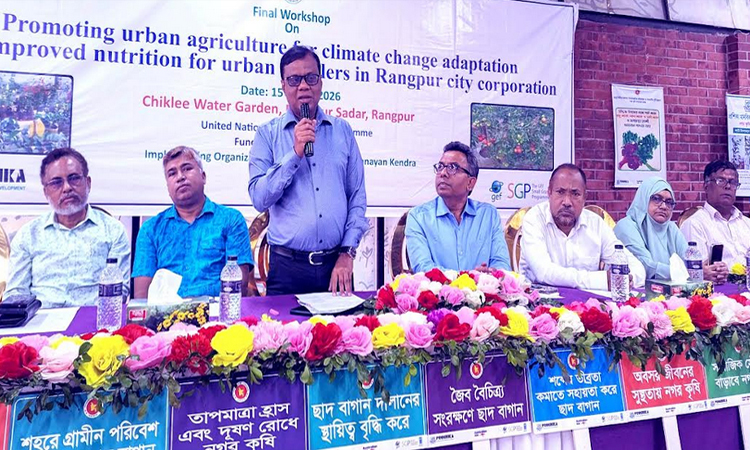
They expressed this view at the closing workshop of a project titled 'Promoting Urban Agriculture for Climate Change Adaptation and Improved Nutrition for Urban Dwellers in Rangpur City Corporation' held at the city's Chiklee Water Garden auditorium on Monday.
Proshika Manobik Unnayan Kendra (PMUK) organised the event under the Small Grants Programme (SGP) of the Global Environment Facility (GEF), implemented by the United Nations Development Programme (UNDP) with financial support from Australian Aid.
Chaired by PMUK Director (Programme) Md AKM Hasan Sayed, Vice-Chancellor of Exim Bank Agricultural University Bangladesh Professor Dr Md Shafiqul Bari attended the workshop as the chief guest.
Head of the Department of Disaster Science and Management at Begum Rokeya University Professor Dr Abu Reza Md Towfiqul Islam, UNDP Representative Mohammad Mozammel Haque, Rangpur Divisional Forest Officer Md Nurul Islam, Rangpur Government Girls High School Headmistress Ferdousi Ashrafi, Lions School and College Principal Enamul Hasan, Rangpur City Corporation Urban Planner Md Nazrul Islam and PMUK Officer Yugesh Chandra Barman addressed the event.
Informing the workshop about the outcome of the 17-month project, PMUK Team Leader Sumona Rani Das said that rooftop agriculture is increasing coolness in Rangpur city by reducing temperature to some extent amidst the scorching heat.
"The city dwellers are ensuring their families' nutritional needs by producing an average of 102 kg of poison-free vegetables from rooftop farming and 171 kg from courtyard farming in two seasons a year," she said.
Rooftop farming activities are helping combat global warming and build a healthy urban life by absorbing harmful carbon dioxide from the environment.
Through this project, agricultural expansion through 100 trained rooftop and soil gardeners has increased the amount of greenery in Rangpur city, reduced carbon emissions through the expansion of horticultural crops and enhanced the skills and capabilities of the beneficiaries.
"The practice of eco-friendly technologies such as proper crop and material selection, prevention of water wastage and integrated pest management (IPM) has also increased the supply of safe and fresh vegetables and fruits," she said.
In addition, through two rooftop gardens at the city's school level, students have become interested in agriculture and environmental activities from an early age.
Teachers, students, researchers, meteorologists, environmentalists, agronomists, producers of tree seedling and organic fertiliser, rooftop gardeners and media workers participated in the workshop.