News Flash
By Selina Shiuly
DHAKA, April 24, 2026 (BSS) - The government has undertaken an initiative to fast-track the digitisation of the Bangladesh Film Archive within the shortest possible timeframe.
Director General of the Bangladesh Film Archive, M. Javed Iqbal, told BSS that digitisation has been prioritised, with the Ministry of Information and Broadcasting issuing directives to accelerate the process.
He said existing challenges—particularly limited storage capacity, a shortage of scanners and constraints in restoration—are being addressed and are expected to be resolved soon.
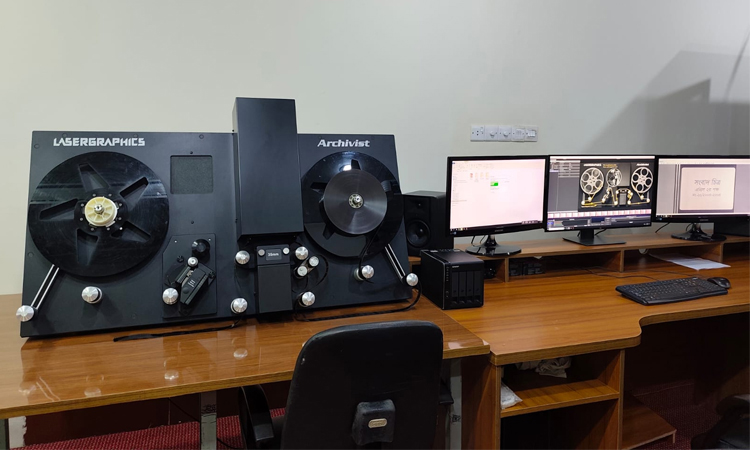
At present, the archive’s digital laboratory relies on a single high-resolution film scanner to convert analogue films into digital format. Due to its extensive collection of 16mm and 35mm films, the digitisation process continues to progress slowly.
“With only one scanner, completing the digitisation of the entire collection is time-consuming,” he said, adding that steps are being taken to enhance technical capacity.
Iqbal said discussions with the ministry have focused on procuring additional scanners and upgrading storage systems, which would significantly speed up the preservation of feature films, short films, documentaries and newsreels.
He noted that the archive’s core mandate is to collect, preserve and exhibit films. Strengthening infrastructure would enable faster conversion of valuable old films into modern digital formats, ensuring long-term preservation.
Sub-Assistant Engineer Mohammad Rashedul Alam Gazi said digitisation often introduces dust and noise artefacts visible in older films.
These issues are corrected in the restoration lab using an AI-based software called “Diamant,” he said.
The software removes dust, scratches, grain, instability and shaking, improving overall picture quality, he added.
However, restoring a full-length film still requires 15 to 20 working days, he said.
Currently, one restoration unit can process one feature film per month, he added.
The digitised materials are stored on servers and hard drives, with plans underway to adopt cloud storage.
Gradual data migration, he said, will help preserve content over the long term as technology evolves.
According to official data, from its establishment in 1978 to March 31 this year, the archive has preserved 1,014 Bangladeshi feature films, 10 Indian films, 100 English-language foreign films, 215 Chinese-language films, 135 short films, 3,421 documentaries and 2,126 newsreels.
Checking of preserved prints, picture negatives, sound negatives and duplicate negatives is ongoing. Additional 16mm newsreels received from Bangladesh Television are yet to be examined, which may further increase the total.
Since July 2012, the archive has digitised 1,188 films and audiovisual materials, including 179 feature and short films, 541 documentaries and news items, and 468 newsreels.
Established in 1978 and renamed in 1984, the Bangladesh Film Archive operates under the Ministry of Information and Broadcasting and plays a vital role in preserving the country’s cinematic heritage.