News Flash
By Ridwan Ahmed
CHITTAGONG UNIVERSITY, May 17, 2026 (BSS) – A new era is set to be ushered in in Bangladesh’s marine research, disaster management, climate monitoring, and the optimal exploration of blue economy potentials, as the country prepares to open a satellite-based marine observation and data analysis facility at Chattogram University (CU).
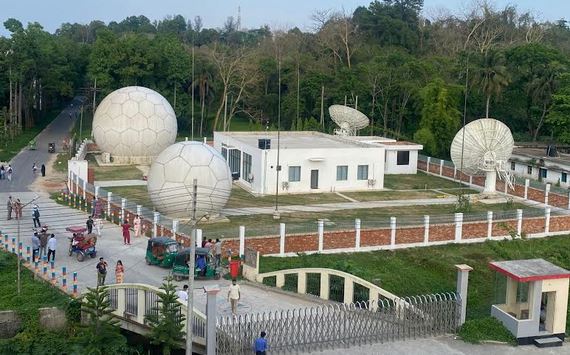
The facility, the first of its kind in the country, titled the “Satellite Ocean Observation and Data Innovation Center (SOODIC)”, is likely to begin trial operations from June 9, as all necessary infrastructure and superstructure work has almost been completed. The center could be considered the country’s largest marine data infrastructure facility.
Experts said the facility is essentially an advanced ocean satellite ground station capable of directly receiving, storing, and analysing data from various Earth observation satellites in space.
Relevant officials said Bangladesh has long depended on foreign agencies for satellite data to forecast cyclones, model coastal flooding, and monitor marine conditions in the Bay of Bengal. Whenever depressions or cyclones formed, authorities had to rely on analyses based on satellite information from agencies such as NASA, NOAA, JTWC, or IMD. Once the data center becomes operational, Bangladesh will, for the first time, have the capability to independently receive and analyse satellite data related to marine activities.
SOODIC is being constructed under the project “Satellite Ground Station for Marine Remote Sensing”, following an agreement signed in Hangzhou, China, in December 2024. The pact was inked between the University of Chittagong and the Second Institute of Oceanography (SIO), a national research institution under China’s Ministry of Natural Resources.
The estimated cost of the project is Tk 80 crore. Of this, SIO has provided nearly Tk 60 crore worth of technical and equipment support, while the university is contributing infrastructure and logistical support worth Tk 20 crore.
The center’s foundation was laid on March 26 last year and is being developed beside the university’s Faculty of Marine Sciences and Fisheries. The facility now includes an advanced server room, satellite antenna systems, data processing units, research laboratories, and display systems. With a storage capacity of nearly 420 terabytes, it is set to become the country’s largest marine data infrastructure.
Meanwhile, the 566th Syndicate meeting held on February 21 took the decision to elevate the facility to an independent center and appointed Professor Dr. Mohammad Muslem Uddin, a teacher of the Department of Oceanography, as its director.
Dr. Muslem told BSS that efforts are currently underway to connect the data center with 11 satellites around the world, with partial connectivity already established with seven of them. In addition to China’s HY-1C/D and FY-4B satellites, preparations are ongoing to collect data from the United States’ NOAA-20, NOAA-21, Aqua, Terra, and Japan’s Himawari-9 satellites.
He further explained that the center is essentially a downlink station established for students and researchers to conduct research on satellite oceanography. It will only receive or download data from designated satellites in space and will not transmit any signals or information back into space.
According to university authorities, as the satellites pass over the Bay of Bengal, they will collect information on sea surface temperature, salinity, wind speed, cloud movement, chlorophyll concentration, wave behavior, sea level changes, deforestation, river erosion, and coastal transformations. These data will be transmitted instantly to the ground station at the university within just a few minutes.
Once operational, the center will also make it easier to identify potential fishing zones in the Bay of Bengal. By analysing sea surface temperature, ocean current patterns, salinity, and chlorophyll concentrations, researchers will be able to determine areas with higher fish availability. Moreover, it will facilitate the analysis of deep-sea temperature and chemical data, supporting oil and gas exploration, marine resource management, and deep-sea research.
“This is not a commercial project. The main objective is to build research and educational capacity. Students and researchers will be able to submit research proposals and collect the required data from here under a structured process,” Prof. Dr. Muslem Uddin explained.
“At present, when we receive cyclone-related information, it is usually identified as data provided by NASA or other foreign agencies. In the future, such information may be identified as data received from SOODIC of Chittagong University,” he said.
Meanwhile, the university administration is planning to transform the center into one of South Asia’s leading marine data hubs in the future. Plans are also underway to introduce high-resolution data services comparable to international research institutions, data subscription services for the fisheries and shipping sectors, SMS-based fishing and weather alerts, and specialized training programs.
CU Vice-Chancellor Prof. Dr. Mohammad Al-Forkan said, “Experimental operations of the data center will begin in early June. Once fully implemented, the center will help unlock the enormous potential of the country’s blue economy. We have plans to make the center more modern, effective, and expansive in the future.”
Pro-Vice Chancellor (Admin) Prof. Dr. Md. Kamal Uddin said, “Once implemented, this project will create new opportunities for the country’s marine economy and research sector. Our students will conduct research using the data collected here, while other universities and research institutions will also be able to access the information.”
The infrastructural work of the center has already been completed, while work on software, algorithms, and data processing systems is now underway. Trial operations are expected to begin between June 7 and 9 in the presence of a Chinese delegation. The official inauguration of the experimental operation is likely to be held on June 9.