News Flash
RAJSHAHI, June 20, 2026 (BSS)- Soil acidity in farmlands of the northern region is increasing at an alarming rate.
Experts say this acidity is acting as a silent killer of crop production, which could pose a major long-term threat to food security.
In this situation, special emphasis has been placed on the proper use of lime and dolomite and on increasing the amount of organic matter to protect soil health.
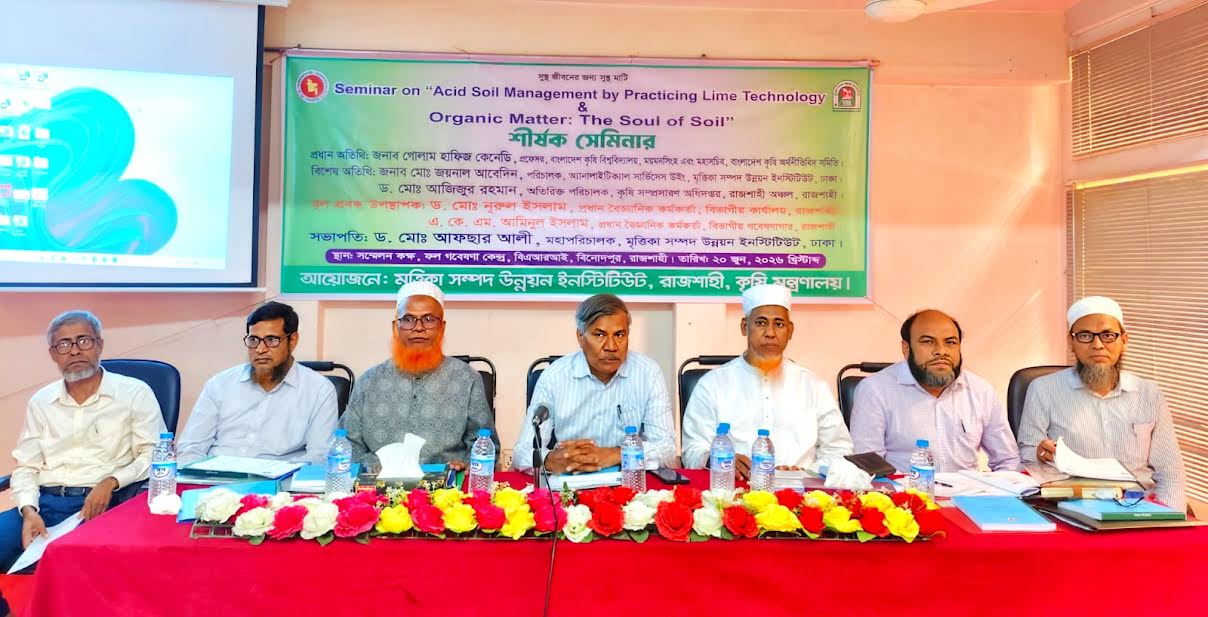
Speakers made these remarks at a day-long seminar held today in the conference room of the Fruit Research Center, Rajshahi.
The event, titled “Seminar on Acid Soil Management by Practicing Lime Technology and Organic Matter: The Soul of Soil,” was organized by the Rajshahi office of the Soil Resource Development Institute (SRDI).
The chief guest at the seminar was Professor Golam Hafiz Kennedy, Secretary General of the Bangladesh Agricultural Economists Association and professor at Bangladesh Agricultural University.
The event was chaired by Dr. Afsar Ali, Director General of the SRDI. Special guests included Joynal Abedin, Director of the Analytical Services Wing of the institute, and Dr. Md. Azizur Rahman, Additional Director of the Department of Agricultural Extension (DAE).
Professor Dr. Md. Mahmudul Hasan from the Department of Agronomy and Agricultural Extension, University of Rajshahi, spoke as a discussant.
The keynote paper was presented by Dr. Nurul Islam, Principal Scientific Officer of SRDI’s Rajshahi Divisional Office, and A.K.M. Aminul Islam, Principal Scientific Officer of the Rajshahi Divisional Laboratory.
The paper detailed the causes of acid soil formation, its impact on crop production, and the effectiveness of lime technology.
Speakers said that 17 essential nutrients are required for crops. While carbon, oxygen, and hydrogen are taken from air and water, the remaining elements must come from the soil.
These nutrients are readily available when the soil pH is between 5.6 and 7.3. But large areas of soil in the northern region are now excessively acidic, leading to deficiencies in phosphorus, calcium, magnesium, and molybdenum, as well as increased toxic effects of aluminum and iron.
According to researchers, the rate of dolomite application depends on soil pH, organic matter content, and texture.
Generally, 3 to 10 kg of dolomite can be applied per decimal—less for sandy soil and more for clay soil. When applied at the correct rate, soil acidity decreases and a favorable environment for nutrient uptake is created.
Speakers further said that when organic matter in soil decreases, its water-holding capacity and fertility decline. That’s why organic matter is called the ‘soul’ of soil. Soil structure can be improved through the use of cow dung, compost, vermicompost, and green manure.
They stressed that dependence on chemical fertilizers alone must be reduced and sustainable agriculture ensured through soil-test-based use of lime and organic fertilizers.
They also called for increased coordination among the SRDI, the DAE and research institutions.
Participants at the seminar agreed that healthy, vibrant soil is essential to combat the adverse effects of climate change and ensure food security.
Therefore, there is no alternative to taking integrated initiatives now to restore the ‘soul’ of the soil.