Wednesday
19 August, 2026
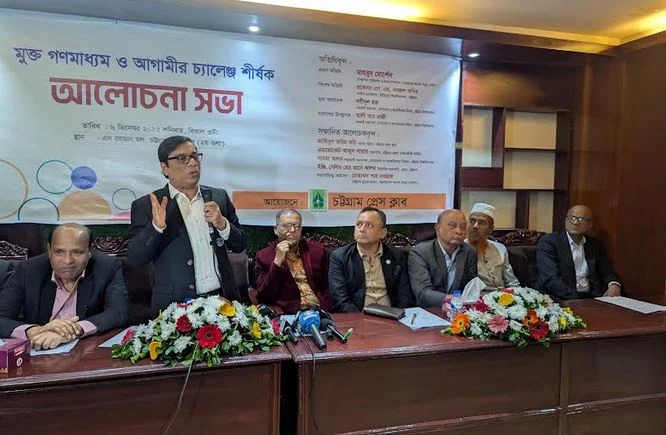
CHATTOGRAM, Dec 6, 2025 (BSS) - Bangladesh Sangbad Sangstha (BSS) Managing Director and Chief Editor Mahbub Morshed today said the credibility crisis regarding corporate media news is increasing worldwide.
“That’s why even giant and porofessional media outlets like the BBC have introduced mobile journalism. They have understood that raw but factual videos or posts on social media are more acceptable to people than descriptive news,” he said.
Mahbub Morshed, also a poet and writer, made the remarks while addressing a discussion titled “Free Media and the Challenges of the Future” at the S Rahman Hall of the Chattogram Press Club (CPC).
BSS Chattogram Bureau Chief Mohammad Shah Nawaz presided over the discussion organised by CPC. Chittagong University (CU) Communication and Journalism Department Assistant Professor Ali R Razi presented the concept paper.
Premier University Vice-Chancellor Professor S M Nasrul Qadir was present as special guest while CU Department of Communication and Journalism Associate Professor Shahidul Haque presented the keynote paper.
Citing the example of the effective role of mobile and other non-conventional media during the July Uprising, Mahbub Morshed said, “We are not yet mentally prepared to accept the modern information flow based on technology and social media. We are stuck in a kind of old-fashioned way. We will read newspapers. But, the biggest challenge now is to accept the new media.”
He said, “We will be able to move forward only by embracing new technologies. The negative aspects must be resolved through discussion. It is not possible to establish democracy unless we abandon the mentality of suppression, oppression and control.”
“In the new Bangladesh that has been created in 2024, we will have to move forward with an open, democratic mindset,” he noted.
The BSS Chief Editor said, “We want freedom for the newspapers and televisions that run through corporate investment, that are mainly owned, controlled by the government and the law, and that have close ties with them.”
Mahbub Morshed said, “Many of us participated in the July uprising. If we recall, what was the role of the conventional media then? Did we get to see enough news of the uprising through state-registered newspapers or institutions? . . . We saw very little. Almost all televisions had become 'BTV'. They had become the mouthpieces of the government propaganda. A large part of the conventional, registered, and conventional media either opposed this movement or completely blacked it out. So who disseminated the news of the uprising? It’s the new media.”
Professor S M Nasrul Kadir said, “Even after five decades of independence, we still have to discuss 'free media and the challenges of the future'. If each of us is honest in our place, then only we will be able to reach our desired goal.”
Shahidul Haque said, “We must take a vocal role against misreporting, such as defamation of others, slandering others, and spreading false information, to ensure the freedom and credibility of the media. Freedom of the press and democracy must run parallel like a railway line.”
Assistant Professor Ali R Raji said a democratic society and state want 'free press'. “If democracy is to be preserved, we need free press and if we want to preserve free press, we need democracy,” he added.
CPC member Golam Maula Murad moderated the discussion while CPC member secretary Zahidul Karim Kochi, Chattogram District Bar Association president Advocate Abdus Sattar, Chattogram University’s Communication and Journalism Department Associate Professor Saima Alam, Divisional President of Association of Engineers Bangladesh Eng Selim Md Jane Alam, Advocate Zia Habib Ahsan, CMUJ general secretary Saleh Noman, Daily Kaler Kantho bureau chief Mustafa Naeem, Daily Inqilab deputy bureau chief Rafiqul Islam Selim and Daily Amar Desh bureau chief Sohag Kumar Biswas, among others, addressed the discussion.