News Flash
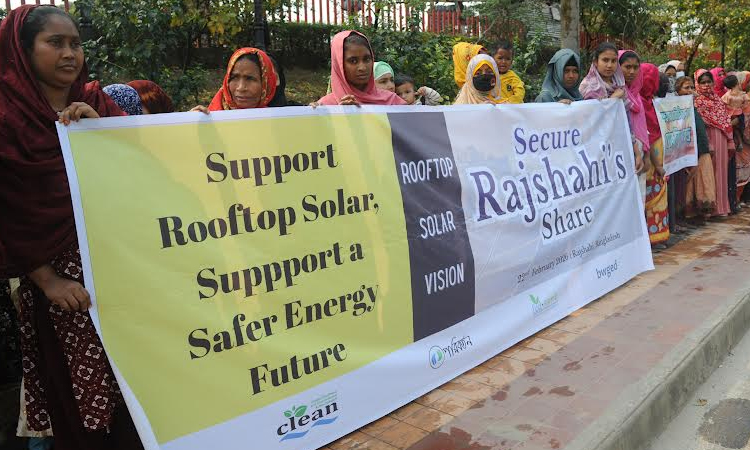
RAJSHAHI, Feb 22, 2026 (BSS)- Civil society members and community representatives have demanded that rooftop solar energy technology be
declared a national priority to ensure Bangladesh's sustainable energy security, environmental protection, and the desired transformation of the
power sector.
Speakers at the event included women leaders Farida Begum and Abeda Begum, Paribartan Director Rashed Ibne Obaid Ripon, Campaign Associates Rony Roy and
Soma Bhowmik, among others.
During a human chain programme held in the Panchabati area in the city today, they stated that achieving renewable energy targets would not be possible
without the active support and direct participation of local government institutions.
The programme was jointly organised by Paribartan, Poribesh O Unnayan Forum-Rajshahi, CLEAN, BWGED, and other local community platforms.
Local journalists, youth representatives, women leaders, and environmental activists took part in the event.
Speakers said that for a long time, Bangladesh's power sector has prioritized centrally managed, costly, and import-dependent fossil fuels, which are now
putting significant pressure on the economy.
In contrast, rooftop solar is a clean, accessible, and comparatively low-cost solution, yet it is not receiving adequate importance at the policy-making
level.
They further noted that rooftop solar is not just a power generation technology; it is also an effective means of establishing "energy democracy"
for ordinary people.
If unused rooftops of union parishad buildings, educational institutions, hospitals, and rural markets are brought under solar power generation, a
strong local-level energy transition can begin.
The speakers mentioned that a vast number of unused rooftops exist in both rural and urban areas.
Planned installation of solar panels on these rooftops would reduce pressure on the national grid and decrease reliance on imported fossil fuels.
This would save foreign currency and create new employment opportunities by developing skilled technicians and entrepreneurs at the local level.
In particular, community-based solar power systems could ensure an affordable and equitable energy future for women and low-income families.
At the end of the programme, participants presented a five-point demand to local government bodies and the administration.