News Flash
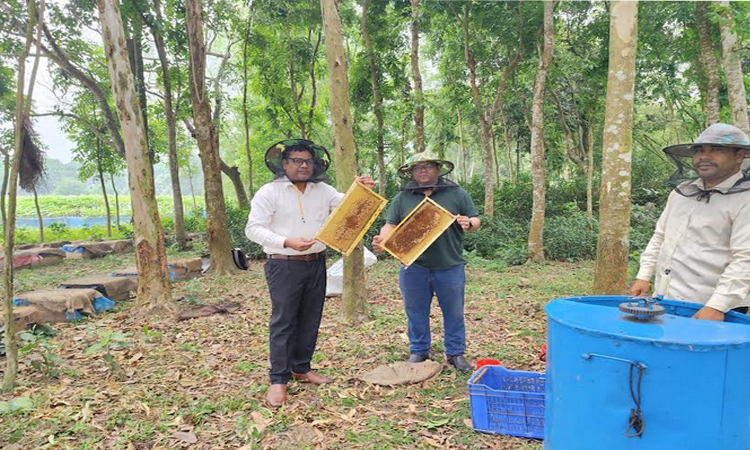
THAKURGAON, April 21, 2026 (BSS) - The Bangladesh Small and Cottage Industries Corporation (BSCIC) has launched a beekeeping initiative in sweet pumpkin fields in Thakurgaon Sadar upazila’s Bardham area, aiming to enhance crop yields and support local honey farmers.
Under this program, bee boxes have been installed commercially in pumpkin fields with support from the BSCIC district office.
Today, the site was visited by BSCIC Thakurgaon Deputy Manager Hafizur Rahman and Department of Environment Assistant Director Tamim Hasan.
During the visit, Tamim Hasan highlighted the environmental and agricultural benefits of the initiative, saying that increased pollination by bees would significantly improve sweet pumpkin production along with contributing to ecological balance.
Hafizur Rahman said that scientific beekeeping in Bangladesh began in 1977 under a BSCIC project. Currently, the company has six honey production centers in Cumilla, Gazipur, Dinajpur, Barishal, Sylhet and Bagerhat.
These centers provide free bee boxes and honey collection equipment to trained farmers, along with low-interest loans and marketing support through fairs.
He also pointed out that the country’s only government honey processing plant is located in Dhamrai Industrial City in Dhaka. Due to the absence of such a facility in Thakurgaon, local farmers often sell raw honey at low prices, leading to financial losses and wastage.
However, the ongoing development of a 50-acre “BSCIC Food Processing Industrial City” in Thakurgaon is expected to address this issue. Several entrepreneurs have already shown interest in establishing honey processing plants there.
Rahman emphasized the need for a new BSCIC project to modernize beekeeping practices. While a large-scale program ran from 2012 to 2019, activities are currently limited. Plans are underway to expand the capacity of the Dhamrai plant and establish an additional processing facility.
He added that beyond honey production, there is strong potentials for production of high-value products such as royal jelly, bee venom, and pollen, which could significantly improve the livelihoods of beekeepers.
Officials expressed optimism that with modern technology and sustained government support, the region could witness a major transformation in beekeeping and related agro-industries.