News Flash
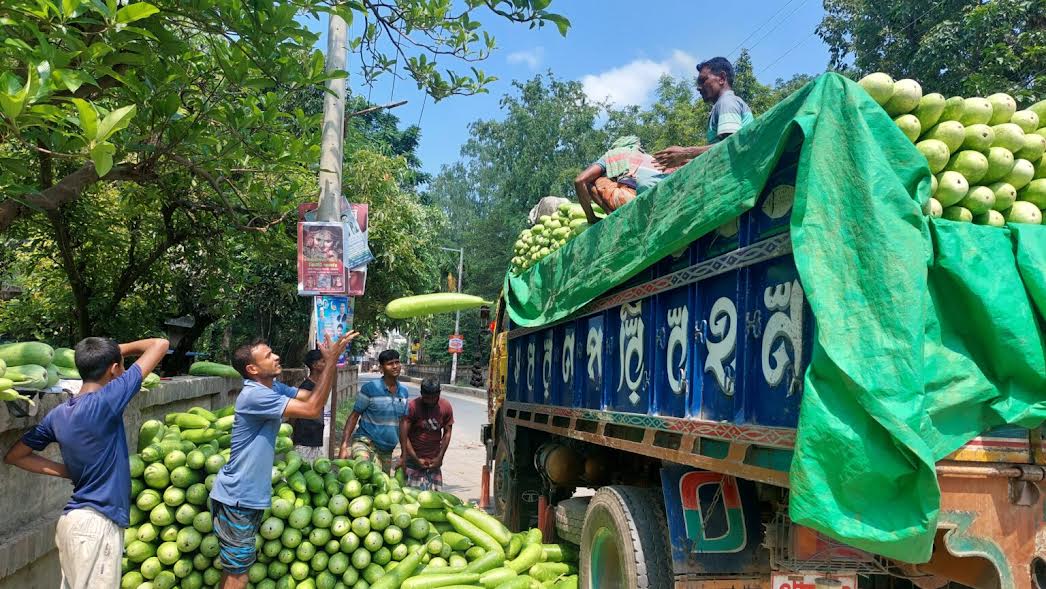
RAJSHAHI, June 1, 2026 (BSS)- Immediately after Eid-ul-Azha, bottle gourd prices in Rajshahi have crashed. At almost every intersection of paved and unpaved roads in the upazilas, each gourd is being sold for only Taka 5.
Yet as soon as the same gourd changes hands and reaches different parts of the country, the price rises more than tenfold.
As a result, while middlemen and wholesale traders are making huge profits, local farmers are facing severe losses, unable to even recover their production costs.
Gourd farmers said that before Eid they sold each gourd for Taka 35 to 40. But just two or three days after Eid, they now have to sell the same gourd for only Taka 5.
They say that at this price, they will not even cover the cost of cultivation.
According to the Department of Agriculture, a record amount of bottle gourd has been produced this season in the nine upazilas of Rajshahi district.
Every day, farmers' gourds are displayed and traded on rural roads and at roadside intersections. From there, wholesalers load the gourds onto trucks and supply them across the country.
The Rajshahi District Department of Agricultural Extension said that breaking all previous records, gourds have been cultivated on 666 hectares of land in the district this year, compared to 521 hectares last year.
The most cultivation in the district has been in Durgapur, Bagha, Godagari, Paba and Puthia upazilas.
Visiting several upazilas including Durgapur, Puthia and Bagmara, fields were seen full of gourds hanging from trellis after trellis.
Wholesale traders are buying gourds directly from farmers in the fields and at road intersections for next to nothing.
By noon, those gourds are loaded onto trucks and sent to various places across the country including Dhaka, Gazipur, Narayanganj, Khulna, Barisal, Sylhet and Chattogram.
An investigation found that while traders are buying gourds from farmers in remote villages at nominal prices using Eid as an excuse, the picture is completely opposite in retail markets in other regions.
Traders are forming syndicates to cheat farmers and are making more than ten times the profit by sending the produce far away.
Imran Ali, a resident of Debipur village in Durgapur municipality, said, "After the Eid holiday ended, I came to Narsingdi from my village home on Saturday for work. On the way I saw traders buying gourds for only 5 taka a piece at the intersection in front of our house.”
“And today in the Narsingdi market, I see that same Rajshahi gourd being sold for Taka 65 to 70 each! Traders are making more than ten times profit on each gourd. This is how a huge price gap for vegetables is being created between villages and cities," he added.
Kamrul Hasan from Naopara village in the same upazila, who now lives in Mohakhali, Dhaka, said over the phone, "I celebrated Eid in Dhaka this time. Some mangoes and gourds were sent from home through an acquaintance.”
He also said, “I heard the price of gourds in our area is now Taka 5. Yet in Dhaka markets this gourd becomes Taka 70 to 75 taka. As a result, village farmers never get a fair price for vegetables."
On Sunday morning, a wholesale trader Abdul Alim was buying gourds at the Durgapur upazila town intersection.
Defending his position, he said, "Because it is the Eid season, there is a severe transport crisis. With drivers and helpers on holiday, travel and supply costs have increased a lot.”
Meanwhile, “Gourds are rotting in the farmers' fields, so the price is low. Even if the price rises after changing hands, we don't make much profit because of transport costs," he added.
However, expressing anger over the fear of losses, gourd farmer Anwarul Islam said, "I have a lot of gourds on trellises on my 15 katha of land. I have just started selling.
“On the first day I sold 40 gourds at 32 taka each. But after Eid the price suddenly fell. If this price continues, I will incur huge losses from gourd cultivation this time," he continued.
When asked, Nasir Uddin, Deputy Director of the Rajshahi District Department of Agricultural Extension, said, "Because of syndicates, a huge gap in vegetable prices between villages and cities is often created. We regularly send reports on this to the higher authorities of the government."
He added, "This year, more gourds have been cultivated in the district than at any time in the past. Farmers in this region build trellises and grow gourds on the same land after harvesting potatoes and onions.”
He said: “Every day, wholesalers buy gourds directly from farmers at paved roads or intersections and supply them across the country. We are emphasizing market monitoring to protect farmers' interests."